Monday, January 30, 2012
Occupy Talks: Indigenous Perspectives on the Occupy Movement
What does it mean to ‘Occupy already occupied lands?’. How does Occupy relate to 500 years of resistance on Turtle Island? Please join speakers Tom B.K. Goldtooth, Clayton Thomas-Muller and Leanne Simpson to explore and discuss these dynamics of the Occupy movement.
Where: Beit Zatoun, 612 Markham Street
When: January, 23rd, 7 pm
Tom B.K. Goldtooth is the Executive Director of the Indigenous Environmental Network (IEN), headquartered at Bemidji, Minnesota. A social change activist within the Native American community for over 30 years, he has become an environmental and economic justice leader, locally, regionally, nationally and internationally. Tom co-produced an award winning documentary film, Drumbeat For Mother Earth, which addresses the affects of bio-accumulative chemicals on indigenous peoples, and is active with many environmental and social justice organizations besides IEN. Tom is a policy advisor on environmental protection, climate mitigation, and adaptation. Tom co-authored the REDD Booklet on the risks of REDD within indigenous territories and a member of the International Indigenous Peoples Forum on Climate Change -- the indigenous caucus within the UNFCCC.
Clayton Thomas-Muller, of the Mathias Colomb Cree Nation also known as Pukatawagan in Northern Manitoba, Canada, is an activist for Indigenous rights and environmental justice. With his roots in the inner city of Winnipeg, Manitoba, Canada, Clayton began his work as a community organizer, working with Aboriginal youth. Over the years Clayton’s work has taken him to five continents across our Mother Earth. Based out of Ottawa, Ontario, Canada, Clayton is involved in many initiatives to support the building of an inclusive movement for energy and climate justice. He serves on the board of the Global Justice Ecology Project and Canadian based Raven Trust. Recognized by Utne Magazine as one of the top 30 under 30 activists in the United States and as a “Climate Hero 2009” by Yes Magazine, Clayton is the Tar Sands Campaign Director for the Indigenous Environmental Network. He works across Canada, Alaska and the lower 48 states with grassroots indigenous communities to defend against the sprawling infrastructure that includes pipelines, refineries and extraction associated with the tar sands, the largest and most destructive industrial project in the history of mankind.
Leanne Betasamosake Simpson is a writer, activist, and scholar of Michi Saagiik Nishnaabeg ancestry and is a band member of Alderville First Nation. She holds a Ph.D. from the University of Manitoba, is an Adjunct Professor in Indigenous Studies at Trent University and an instructor at the Centre for World Indigenous Knowledge, Athabasca University. She has also lectured at Ryerson University, the University of Victoria, the University of Manitoba, and the University of Winnipeg. Leanne has worked with Indigenous communities and organizations across Canada and internationally over the past 15 years on environmental, governance and political issues. She has published three edited volumes including Lighting the Eighth Fire: The Liberation, Resurgence and Protection of Indigenous Nations (2008, Arbeiter Ring), and This is An Honour Song: Twenty Years Since the Barricades (with Kiera Ladner, 2010, Arbeiter Ring). Leanne has published over thirty scholarly articles and raised over one million dollars for community-based research projects over her career. She has written fiction and non-fiction pieces for Now Magazine, Spirit Magazine, the Globe and Mail, Anishinabek News, the Link, and Canadian Art Magazine.
Event is FREE, donations welcomed.
Important note: Beit Zatoun is accessible for the lecture, however its washrooms are not. Accommodations will be made with local restaurants to provide accessible washrooms.
Sponsors: Canadian Auto Workers, Canadian Labour Council, Ryerson University, Environmental Justice Toronto, Indigenous Environmental Network
Media Sponsor: rabble.ca


For the next 7 generations
Please read below the video too!
For The Next 7 Generations Trailer from Laughing Willow on Vimeo.
Good morning,
The ISA has been approached with an
exciting opportunity for a film screening this March 26th right here at
OttawaU. It is entitled: "For the Next seven Generations"
Please see the following link to
view the trailer and the website which contains the bios of the
Grandmothers, past screenings:
www.forthenext7generations.com
As well as the screening, on of the
Grandmothers will be here and we are hoping to have a facilitated
discussion after the screening.
Also we are seeking interested students/staff to help volunteer and plan for this exciting event.
(taken from the website)
About
Synopsis:
In
2004, thirteen Indigenous Grandmothers from all four corners, moved by
their concern for our planet, came together at a historic gathering,
where they decided to
form an alliance: The International Council of Thirteen Indigenous
Grandmothers. This is their story. Four years in-the-making and shot on
location in the Amazon rainforest, the mountains of Mexico, North
America, and at a private meeting with the Dalai Lama
in India, For the Next 7 Generations follows what happens when these
wise women unite. Facing a world in crisis, they share with us their
visions of healing and a call for change now, before it's too late. This
film documents their unparalleled journey and
timely perspectives on a timeless wisdom.
Grandmother's Mission Statement:
"We,
the International Council of 13 Indigenous Grandmothers, represent a
global alliance of prayer, education and healing for our Mother Earth,
all her inhabitants,
all the children, and for the next seven generations to come. We are
deeply concerned with the unprecedented destruction of our Mother Earth
and the destruction of indigenous ways of life. We believe the teachings
of our ancestors will light the way through
an uncertain future. We look to further our vision through the
realization of projects that protect our diverse cultures: lands,
medicines, language and ceremonial ways of prayer and through projects
that educate and nurture our children."
We are planning to hold a meeting next week to start discussing the details and planning for the screening.
Thursday, January 26, 2012

First Nations Child and Family Caring Society (FNCFCS) and the Assembly of First Nations (AFN)

Greets to you all!
Sylvia Smith here from Project of Heart. Happy Thursday evening!
I have some bad news and some good news....
The bad news is that I just got word (a couple of hours ago) that the powers-that-be changed the site of the Federal Court to hear the Appeal yet again!!
But the good news is two-fold: 1) They have promised a change in venue will NOT happen again, and 2) The site of the Federal Court to hear the Appeal has been changed BACK to the Supreme Court location at 301 Wellington Street.
If you are a teacher and your students' bookings have been deleted, you will need to input the data once again to save your space in the court room. If you are a teacher and have not yet reserved a space, please do so as quickly as possible, as it is "first come, first serve". There are 75 seats available for all 6 sessions.
For your information, the Have a Heart activities that are being led by elementary school children will still take place on Parliament Hill from 10:30 to 11:30. The rally in support of the children will take place there as well.
Once again, I'm so sorry about all the changes and the confusion/frustration that is the result of this. It will all be worth it. As a gesture of reconciliation, let us let the Government of Canada know, through our presence at the Federal Court on Feb. 13 to 15, that First Nations children deserve the same benefits as all other Canadians! We Are the Change!
I hope you are all looking forward to a wonderful weekend!
Best,
Sylvia
P.S.
There is a cafeteria in the Supreme Court for those of you will want something over the noon break. As well, the Families of Sisters in Spirit will be holding their rally over the noon hour on Parliament Hill, so your support in their cause (awareness and action for the families of the Aboriginal women and girls who have gone missing or have been murdered) would be very appreciated as well.
--------------------------------------------------------
To all "Have a Heart" for First Nations Children supporters,
A quick note to inform you that:
1) Unfortunately, the site of the HR Tribunal Appeal has changed from the Federal Court in the Supreme Court, to the Federal Court located on the 10th floor at 90 Sparks Street.
If you decide you are not attending the court, please take your name off the scheduling plan (doodle). The present court has room for 20 to 30 people only (over-flow room pending).
2) The "Have a Heart" activities that were scheduled to take place on the lawn outside the Supreme Court have been moved to Parliament Hill.
- 10:30 Welcome to the youth (elementary and high school students)
- 10:40 to 11:20 Students read their letters/poems to government officials, then put them in mailbox
- 11:20 to 11:30 Students sing "Diamonds in the Snow" (dedicated to Shannen Koustachin from Attawapiskat)
Come out and support these children and youth in their desire to see First Nations children and youth have the same opportunities as all other Canadians enjoy. It is time to see equity become reality!
Updates will be provided.
Tuesday, January 24, 2012
Events and actions - Be able to respond!
Green Week activities - Activités de la Semaine verte
http://www.facebook.com/events/241769825898823/
National Day of Action! Wednesday, 1st February 2012, MRT terrasse, 10:30
With the sustainable development crew!
Journée nationale d'action! Mercredi, 1er février 2012, MRT terrasse 10h30
Avec la gang de développment durable!
Confronting UNsustainability! A panel about Austerity in a Time of
Ecological Crisis, Wednesday, February 1st
Alumni Auditorium (University Center of the University of Ottawa) at 7pm
L’austérité en temps de crise écologique : une discussion, Mercredi, 1er février
Auditorium des anciens (Centre universitaire de l'Université d'Ottawa) à 19h
Aboriginal perspectives on environmental issues Monday, February 6th
90 University Lounge at 6pm
Perspectives autochtones sur les questions environnementales
Lundi, 6 février
Salon du 90 Université à 18h
Farmers' Market Wednesday, February 8, 2012
University Centre, main floor, 9am to 4pm
Marché des fermiers Mercredi 8 février 2012 Centre Universitaire, plancher principal, 9h à 16h
Let’s Get Some (direct) Action Workshop
Wednesday, February 8th at UCU 206, 1pm
In collaboration with the International Development Week
Atelier d'action directe dans un temps de crise environnementale Mercredi 8 février au UCU 206 à 13h,
En collaboration avec la Semaine du Développement Internationale
Where’s our Tuition Going? Workshop with the Just Investment Coalition
Thursday, February 9 at MRT 250, 2:30pm
In collaboration with the International Development Week
Où vont nos frais de scolarité ? Atelier avec CIJIC sur l'investissement juste
Jeudi 9 février au MRT 250 à 14h30
En collaboration avec la Semaine du Développement Internationale
http://www.facebook.com/events/241769825898823/
National Day of Action! Wednesday, 1st February 2012, MRT terrasse, 10:30
With the sustainable development crew!
Journée nationale d'action! Mercredi, 1er février 2012, MRT terrasse 10h30
Avec la gang de développment durable!
Confronting UNsustainability! A panel about Austerity in a Time of
Ecological Crisis, Wednesday, February 1st
Alumni Auditorium (University Center of the University of Ottawa) at 7pm
L’austérité en temps de crise écologique : une discussion, Mercredi, 1er février
Auditorium des anciens (Centre universitaire de l'Université d'Ottawa) à 19h
Aboriginal perspectives on environmental issues Monday, February 6th
90 University Lounge at 6pm
Perspectives autochtones sur les questions environnementales
Lundi, 6 février
Salon du 90 Université à 18h
Farmers' Market Wednesday, February 8, 2012
University Centre, main floor, 9am to 4pm
Marché des fermiers Mercredi 8 février 2012 Centre Universitaire, plancher principal, 9h à 16h
Let’s Get Some (direct) Action Workshop
Wednesday, February 8th at UCU 206, 1pm
In collaboration with the International Development Week
Atelier d'action directe dans un temps de crise environnementale Mercredi 8 février au UCU 206 à 13h,
En collaboration avec la Semaine du Développement Internationale
Where’s our Tuition Going? Workshop with the Just Investment Coalition
Thursday, February 9 at MRT 250, 2:30pm
In collaboration with the International Development Week
Où vont nos frais de scolarité ? Atelier avec CIJIC sur l'investissement juste
Jeudi 9 février au MRT 250 à 14h30
En collaboration avec la Semaine du Développement Internationale
Monday, January 23, 2012
Movie screenings coming up!
IPSMO to present "Kinàmàgawin: Aboriginal Issues in the Classroom" and "Reel
Injun" at OPIRG Ottawa Film Festival
On Wednesday, January 25, 2012, the Indigenous Peoples Solidarity Movement
Ottawa (IPSMO) will present the following films as part of the OPIRG Ottawa
Film Festival:
2:00 PM: Kinàmàgawin: Aboriginal Issues in the Classroom
A film by Canadian Studies MA student Melissa Santoro Greyeyes-Brant and
filmmaker/Carleton University alumnus Howard Adler, "Kinamagawin: Aboriginal
Issues in the Classroom" examines the difficulties and challenges in
discussing Aboriginal issues in post-secondary classrooms. See the trailer
at http://www.youtube.com/watch?v=_vjQgpEryVM
Q&A with the filmmakers after the screening
8:00 PM: Reel Injun
(Presented in partnership with the Aboriginal Studies Program of the
University of Ottawa)
³Reel Injun² takes an entertaining and insightful look at the Hollywood
Indian, exploring the portrayal of North American Natives through the
history of cinema. Travelling through the heartland of America, Cree
filmmaker Neil Diamond looks at how the myth of ³the Injun² has influenced
the world¹s understanding and misunderstanding of Natives.
Location: University of Ottawa, University Centre Agora
Facebook event: https://www.facebook.com/events/128135853972830/
Injun" at OPIRG Ottawa Film Festival
On Wednesday, January 25, 2012, the Indigenous Peoples Solidarity Movement
Ottawa (IPSMO) will present the following films as part of the OPIRG Ottawa
Film Festival:
2:00 PM: Kinàmàgawin: Aboriginal Issues in the Classroom
A film by Canadian Studies MA student Melissa Santoro Greyeyes-Brant and
filmmaker/Carleton University alumnus Howard Adler, "Kinamagawin: Aboriginal
Issues in the Classroom" examines the difficulties and challenges in
discussing Aboriginal issues in post-secondary classrooms. See the trailer
at http://www.youtube.com/watch?v=_vjQgpEryVM
Q&A with the filmmakers after the screening
8:00 PM: Reel Injun
(Presented in partnership with the Aboriginal Studies Program of the
University of Ottawa)
³Reel Injun² takes an entertaining and insightful look at the Hollywood
Indian, exploring the portrayal of North American Natives through the
history of cinema. Travelling through the heartland of America, Cree
filmmaker Neil Diamond looks at how the myth of ³the Injun² has influenced
the world¹s understanding and misunderstanding of Natives.
Location: University of Ottawa, University Centre Agora
Facebook event: https://www.facebook.com/events/128135853972830/
Sunday, January 22, 2012
Support the Algonquins of Barriere Lake
Tuesday, Jan. 24
Support the Algonquins of Barriere Lake -
Demand Canada Remove Their Indian Act Band Council & Recognize Barriere Lake's Customary Government
In
April 2010, the Minister of Indian Affairs imposed a foreign system of
governance (Indian Act electoral system) on the Algonquin First Nation
of Barriere Lake to avoid honouring the signed agreements and
recognizing legitimate leadership.
At
10 am, on Tuesday, Jan. 24 as the Crown and First Nations leaderships
gathered at the old Ottawa City Hall, come out to join Barriere Lake
Algonquins at a rally in front of the meeting place to show your
solidarity and demand OUR government:
REVOKE SECTION 74 OF INDIAN ACT!
RECOGNIZE BARRIERE LAKE's CUSTOMARY CHIEF AND COUNCIL!
RESPECT BARRIERE LAKE'S SOVEREIGNTY AND SELF-DETERMINATION!
10 am
Old City Hall, 111 Sussex Drive, Ottawa, unceded Algonquin Territory.
Map & Directions:http://www.csps-
Bring creative signs and banners!
Harper has nothing to teach us about democracy!
For a good background video on Section 74 and the Barriere Lake struggle, see this short 4-minute film: http://vimeo.com/
For more detailed information: http://ipsmo.
11th Annual New Sun Conference on Aboriginal Arts
11th Annual
New Sun Conference on Aboriginal Arts:
RECONFIGURED REALITIES
Saturday, March 3, 2012, 9:00 am - 4:30 pm
Room 5050, 5th Floor, Minto Centre, Carleton University
Featuring:
KC Adams
Multimedia visual artist and photographer
Christine Welsh
Documentary film maker and educator
John Kim Bell
Arts producer, composer, conductor
Skawennati
New media artist
Stephen Leafloor and BluePrintForLife
“Social work through HipHop”
featuring
DJ Creeasian and throat singer Evie Mark
Elder Jim Albert in attendance
Registration: Students $45; non-students $65 (HST included)
Includes a gourmet luncheon of Native cuisine and a performance by BluePrintforLife
• Limited seating • Pre-registration STRONGLY advised •
• Parking: $2 for the day • OC Transpo nearby •
To register, call 613-520-2600, ext. 4035, or e-mail allan_ryan@carleton.ca
New Sun Conference on Aboriginal Arts:
RECONFIGURED REALITIES
Saturday, March 3, 2012, 9:00 am - 4:30 pm
Room 5050, 5th Floor, Minto Centre, Carleton University
Featuring:
KC Adams
Multimedia visual artist and photographer
Christine Welsh
Documentary film maker and educator
John Kim Bell
Arts producer, composer, conductor
Skawennati
New media artist
Stephen Leafloor and BluePrintForLife
“Social work through HipHop”
featuring
DJ Creeasian and throat singer Evie Mark
Elder Jim Albert in attendance
Registration: Students $45; non-students $65 (HST included)
Includes a gourmet luncheon of Native cuisine and a performance by BluePrintforLife
• Limited seating • Pre-registration STRONGLY advised •
• Parking: $2 for the day • OC Transpo nearby •
To register, call 613-520-2600, ext. 4035, or e-mail allan_ryan@carleton.ca
For a registration form and more information visit www.trickstershift.com <http://www.trickstershift.com>
A free screening of the films Finding Dawn and Arctic HipHop
will take place in Carleton’s Bell Theatre on Sunday, March 4, 1-5 pm.
A free screening of the films Finding Dawn and Arctic HipHop
will take place in Carleton’s Bell Theatre on Sunday, March 4, 1-5 pm.
Luncheon Menu:
• Bannock bread with maple butter and cloud berry compote
• Roasted corn and bacon soup
• Pickled root vegetable salad
• Mixed salad with sweet and bitter greens and saskatoon berries
• Seven grain rice casserole with little neck clams
• Sweet roasted squash
• Smoked duck ragout with celery root, winter vegetables and wild mushrooms
• Spicy pumpkin seed-crusted salmon fillet
• Corn and maple pudding with edible bush berries
• Bannock bread with maple butter and cloud berry compote
• Roasted corn and bacon soup
• Pickled root vegetable salad
• Mixed salad with sweet and bitter greens and saskatoon berries
• Seven grain rice casserole with little neck clams
• Sweet roasted squash
• Smoked duck ragout with celery root, winter vegetables and wild mushrooms
• Spicy pumpkin seed-crusted salmon fillet
• Corn and maple pudding with edible bush berries
Presenter Biographies
KC Adams
KC Adams is a Winnipeg-based artist who works in a variety of media -- sculpture, installation, drawing, painting, photography, ceramics, printmaking and kinetic art. She has had several solo exhibitions, most recently Legacy at the Parramatta Artists Studios, in Parramatta, Australia, and has been featured in numerous group exhibitions, including: Anthem: Perspectives on Home and Native Land at the Carleton University Art Gallery, Circuit City at My Winnipeg, at la maison rouge gallery in Paris, The Language of Intercession at the Oboro Gallery in Montreal, and Cyborg Hybrids at Photoquai: Biennale des images du monde in Paris. She has done residencies at the Banff Centre, the Confederation Art Centre in Charlottetown, National Museum of the American Indian in New York and a Canada Council International residency in Parramatta, Australia. KC has received grants and awards from the Winnipeg Arts Council, Manitoba Arts Council and the Canada Council for the Arts. Twenty pieces from her Cyborg Hybrid series are in the permanent collection of the National Gallery of Canada. She has an extensive background in arts administration in Winnipeg, serving as Administrative Coordinator at Plug IN ICA (Institute of Contemporary Art), Board President at the artist-run centre, aceartinc, and Director of the Urban Shaman Gallery. She has also taught art to children at Art City, Learning Through the Arts, and the Manitoba Arts Council's Artist in the Schools program. KC is a graduate of Concordia University and holds a BFA in studio arts.
www.kcadams.com <http://www.kcadams.com>
Christine Welsh
Christine Welsh is a producer, writer and film director known for her strong commitment to documenting the experience of Indigenous women in Canada. Her films include Women in the Shadows, a one-hour documentary about her search for her Métis grandmothers. The film won the Best Documentary award at the 1992 Vancouver International Film Festival and was nominated for a Gemini award for Best Documentary. Keepers of the Fire, a tribute to Aboriginal women’s resistance, earned her the honour of being named co-recipient of the first Alanis Obomsawin Award for outstanding achievement in the Canadian Aboriginal film industry. Her most recent film is the feature-length NFB documentary Finding Dawn which profiles three of the estimated 500 Native women who have been murdered or gone missing in Canada over the past thirty years. Christine is currently an Associate Professor at the University of Victoria where she teaches courses in Indigenous Women's Studies and Indigenous Cinema.
John Kim Bell
John Kim Bell is a pianist, composer, conductor, music producer, arts administrator, and was the first person of aboriginal heritage to become a symphony conductor. Born in Kahnawake, he began conducting for the Broadway stage in New York at the age of eighteen. He has composed music for film and television and is the founder of the Canadian Native Arts Foundation, National Aboriginal Achievement Foundation and the National Aboriginal Achievement Awards. Over a period of twenty years, he built the Foundation into Canada’s largest Aboriginal charity. He is a recipient of the Order of Canada, holds six honorary doctorates and, amongst other honours, received a Lifetime Achievement Award from the Royal Conservatory of Music in 2007. His proposal to establish a loan guarantee program for First Nations was successful with Ontario announcing a $250 million loan guarantee program in March 2009. Mr. Bell is currently taking an active role in the development of energy projects involving First Nations. He recently established the Enbridge School Plus Program which awards $1 million to First
Nations schools in Western Canada. Mr. Bell is President of Bell & Bernard Limited, a management consulting firm specializing in First Nations economic development and energy.
Skawennati
Skawennati is a Montreal-based artist and independent curator who holds a Bachelor of Fine Arts and a Graduate Diploma of Institutional Administration from Concordia University. Recipient of the 2011 Eiteljorg Contemporary Art Fellowship, she is recognized as a pioneering New Media artist. Her art, addressing history, the future, and change, has been widely exhibited across Canada, the United States and Australia. She created the Aboriginally-determined, on-line gallery and chat space, CyberPowWow in 1996, followed by Imagining Indians in the 25th Century, a web-based paper doll/time-travel journal which has been presented across North America, most notably in Artrain USA’s three-year, coast-to-coast tour of the show Native Views: Influences of Modern Culture. Her current production, TimeTraveller™, is a multi-platform project featuring a machinima series. Its website, www.TimeTravellerTM.com, won imagineNative’s 2009 Best New Media Award. Additional projects include Artist for the Ethical Treatment of Humans, a subvertising response to an exploitive PETA campaign, and 80 Minutes, 80 Movies, 80s Music, an ongoing series of one-minute music videos. Skawennati is Co-Director of Aboriginal Territories in Cyberspace, a network of artists, academics and technologists investigating, creating and critiquing Aboriginal virtual environments. AbTeC’s Otsì:! <--ESFSECEV-TY3013-----> , a video game mod created with students from the Kahnawake Survival School, won imagineNative’s 2010 Best New Media Award.
www.skawennati.com <http://www.skawennati.com>
Stephen Leafloor
Stephen Leafloor is the founder of BluePrintForLife, which utilizes HipHop as both a community development tool and a model for alternative education. He has over 27 years experience as a social worker in the areas of probation, wilderness programs, street work with youth at risk, residential group homes, child protection and community outreach. Stephen has been active in HipHop culture as a dancer since 1982 and in 1986 completed his Master of Social Work degree at Carleton University with a thesis on HipHop culture and its importance for educators and social workers. He is the founder of the Ottawa-based Canadian Floor Masters -- Canada’s oldest professional Breakdancing/Bboy crew. BluePrintForLife offers dynamic, culturally appropriate programs designed for First Nations and Inuit youth that are founded on HipHop, rooted in traditional culture, and focussed on community needs. Exploring the positive elements of HipHop becomes a survival toolkit for youth while celebrating traditional culture and leadership. In 2010 BluePrintForLife was the first organization from North America ever to be selected as a top finalist in the Freedom to Create awards, the world’s most prestigious award for outreach through the arts.
www.blueprintforlife.ca <http://www.blueprintforlife.ca>
Matthew Wood aka Creeasian
Matthew Wood's Bboy name, Creeasian, is a blend that reflects his Cree and Vietnamese ancestry. He is a senior youth facilitator with BluePrintForLife and an accomplished dancer, DJ, and BeatBoxer (creating drum beats with his mouth). He has been working with youth for the past eleven years and strongly believes in empowerment through music and dance. In 2011 Creeasian won the Rockstar energy drink DJ battle, and the 2011 Redbull DJ battle in Edmonton.
Evie Mark
Evie Mark is from the small Inuit community of Ivujivik in northern Quebec. An accomplished throat singer and skilled translator, she often travels with the BluePrintForLife team helping to integrate traditional Inuit culture into their workshops. Evie is also active in film production and has worked in every facet of this medium from camera work and acting to editing and directing. Her film work focuses on the issues affecting all aspects of life in the north. One of her films was featured at the very first New Sun Conference in 2002.
Wednesday, January 18, 2012
Mixed Blood teachings
[Thanks to Caro for sharing this]
Mixed blood, why do you wonder where you belong?
You have entered the world a child of many races
Giving the peoples of the world a chance to see itself as one, through you.
But you, you have given the Indian people a special gift.
Because you were born with the right to choose any path,
And you choose to pray in the way of our old ones
You honour this land where you were born,
And your prayers give strength to all of your relatives here.
The Grandfathers and Grandmothers are happy that you speak to them,
And we are happy when you remember us
Among all of the Spirits that walk with you,
And we listen to your special prayers for peace and a good life.
Be patient with your Red relatives.
They too grew up in a racist society, and
It is hard for some to find Spirit when they only see faces.
They forget that some of the Grandmothers and Grandfathers were hidden and
forgotten.
Mixed blood, when you walk the way of the people,
You show them that you have not forgotten.
Help them to let go of the shame, help them to remember the teachings
Of the time that was to come, when all of the races came together as one.
It is said that a Nation of Rainbow Warriors would come
And lead the way for Mother Earth to heal from near destruction
Mixed blood, why do you wonder where you belong?
Willi Nolan, 2000
Mixed blood, why do you wonder where you belong?
You have entered the world a child of many races
Giving the peoples of the world a chance to see itself as one, through you.
But you, you have given the Indian people a special gift.
Because you were born with the right to choose any path,
And you choose to pray in the way of our old ones
You honour this land where you were born,
And your prayers give strength to all of your relatives here.
The Grandfathers and Grandmothers are happy that you speak to them,
And we are happy when you remember us
Among all of the Spirits that walk with you,
And we listen to your special prayers for peace and a good life.
Be patient with your Red relatives.
They too grew up in a racist society, and
It is hard for some to find Spirit when they only see faces.
They forget that some of the Grandmothers and Grandfathers were hidden and
forgotten.
Mixed blood, when you walk the way of the people,
You show them that you have not forgotten.
Help them to let go of the shame, help them to remember the teachings
Of the time that was to come, when all of the races came together as one.
It is said that a Nation of Rainbow Warriors would come
And lead the way for Mother Earth to heal from near destruction
Mixed blood, why do you wonder where you belong?
Willi Nolan, 2000
Tuesday, January 17, 2012
Mamihlapinatapai

The word comes from the Yaghan language of Tierra del Fuego, located at the
tip of South America. The islands are divided between Chilean and
Argentinean rule. The land is largely protected as national parks and
reserves.
The Yaghan people are few and many of them
are mestizos. The word mamihlapinatapai landed a spot in the Guinness
Book of World Records as the “most succinct word.”
Roughly translated, the idea of the word refers to “a
look shared by two people, each wishing that the other will offer
something that they both desire but are unwilling to suggest or offer
themselves.”
I’d say it’s a pretty loaded word!
It is pronounce mah-mee-lah-pin-yah-tah-pie
Monday, January 16, 2012
Third World Canada
As part of the Aboriginal Awareness Week, the
Aboriginal Health Interest Group at the University of Ottawa's Faculty
of Medicine, invites you to attend the following events at Roger Guindon
Hall, located at 451 Smith Road, behind the General Hospital.
Thank You. Che Meegwitch.
-
Monday, January 16 at 12:30 - Room 2005 - Presentations by Patrick Laflèche and Jonathan Ferrier on Traditional Medicine
- Tuesday, January 17, at 4:30 - Room 3248 - Sabrina Squires and Renée Vachon, Aboriginal students in their second year of Medicine will talk about their experience working in remote Aboriginal communities.
- Tuesday, January 17, at 5:30 - Room 3248 - Throat Singing Workshop with Lynda Brown
- Wednesday, January 18, at 1:30 - Room 2149 - Showing of Andrée Cazabon's documentary film "Third World Canada" depicting the plight of many First Nations by focusing on the isolated and poverty-stricken community of Kitchenuhmaykoosib Inninuwug (K.I.) in Ontario.
- Thursday, January 19, at 5:30 - Cindy Blackstock, Executive Director of First Nations Child and Family Caring Society of Canada<http://www.fncaringsociety.com/> (FNCFC), who has been one of the country's most committed activists for First Nations children.
Thank You. Che Meegwitch.
All the Dirt
All the Dirt

Reflections on Successful, Cooperative Organic Farming
A Free Reading and Discussion with Farmer Robin Tunnicliffe
A Free Reading and Discussion with Farmer Robin Tunnicliffe
Monday, January 23, 7:00 p.m.
Ottawa Public Library, Main Branch (120 Metcalfe St.)
Ottawa Public Library, Main Branch (120 Metcalfe St.)
Free Admission
Come meet Robin Tunnicliffe – Farmer, USC Canada Board Member, a founder of Saanich Organics, and author of the brand new book, All the Dirt.
Join Robin as she reads from her book and relates the
experiences of three young women following their dreams to become
successful organic farmers and business partners. Copies of the book will be available for purchase and signing.
This is a free event, co-sponsored by USC Canada and Just Food. For further information, please contact Kate by email or by phone 613.234.6827 x228.
Please forward this message to anyone who might be interested.
We Hope to See You There!
Leonard Peltier
Leonard Peltier, Activist
Official website: http://www.leonardpeltier.net/theman.htm

A participant in the American Indian Movement, he went to assist the Oglala Lakota people on the Pine Ridge Reservation in the mid-70s where a tragic shoot-out occurred on June 26, 1975. Accused of the murder of two agents of the Federal Bureau of Investigation (FBI), Peltier fled to Canada believing he would never receive a fair trial in the United States.
On February 6, 1976, Peltier was apprehended. The FBI knowingly presented the Canadian court with fraudulent affidavits, and Peltier was returned to the U.S. for trial.
Key witnesses were banned from testifying about FBI misconduct & testimony about the conditions and atmosphere on the Pine Ridge Reservation at the time of the shoot-out was severely restricted. Important evidence, such as conflicting ballistics reports, was ruled inadmissible. Still, the U.S. Prosecutor failed to produce a single witness who could identify Peltier as the shooter. Instead, the government tied a bullet casing found near the bodies of their agents to the alleged murder weapon, arguing that this gun had been the only one of its kind used during the shootout, and that it had belonged to Peltier.
Later, Mr. Peltier’s attorneys uncovered, in the FBI’s own documents, that more than one weapon of the type attributed to Peltier had been present at the scene and the FBI had intentionally concealed a ballistics report that showed the shell casing could not have come from the alleged murder weapon. Other troubling information emerged: the agents undoubtedly followed a red pickup truck onto the land where the shoot-out took place, not the red and white van driven by Peltier; and compelling evidence against several other suspects existed and was concealed.
At the time, however, the jury was unaware of these facts. Peltier was convicted and sentenced to two consecutive life terms. He is currently imprisoned at the U.S. Penitentiary in Lewisburg, Pennsylvania.
Monsanto's Biopiracy
By Vandana Shiva
April 27, 2004
Zmag
Wheat the Golden grain, is called "Kanak" in North Western India. It is the staple of a large majority. Wheat diversity has been evolved by Indian farmers over millennia for taste, for nutrition, for ecological adaptation to cold climates and hot climates, dry regions and wet regions.
Barely four years after starting work, in December 1909, the book entitled "wheat in India" was published. By 1924 no fewer than thirty one papers exclusively on wheat had appeared. A survey of work was presented to the Royal Society of Arts in 1920.
In 1916-1920 indigenous Indian varieties won prizes in International Grain Exhibitions. Indian Wheat was so important a crop for the British Empire that an important Resolution of the Government of India no. I - 39-50 of March 17th, 1877 was passed on the wheat question requiring the Governor General to provide all information on Indian wheat including "local names for the varieties of wheat cultivated and three description in English". More than 1000 wheat samples in bags of 2 pounds each were sent to the India office, examined by Forbes Watson, and a detailed report provided to the Secretary of the State.
Sir Albert Howard, the founder of Modern Organic Farming and his wife G.L.C. Howard started to document and systematize India's wheat diversity. They identified 37 separate botanical varieties of wheat belonging to 10 sub-species.
The Ghoni, Kanku, Rodi, Mundli, Retti, Kunjhari, Sindhi, Kalhia, Sambhergehna, Sambhau, Kamla, Laila, Dandi, Gangajali, Pissia, Ujaria, Surlek, Manipuri, Anokhla, Tamra, Mihirta, Munia, Gajia, Mundia, Merdha, Dudhia, Lurkia, Jamali, Lalka, Harahwa, Galphulia¬Ö.
An amazing diversity of indigenous wheat was evolved by farmers through their indigenous innovation and knowledge. In 1906, the Howards began to select and systematize Indian wheat in Pusa (Bihar) and Lyallpur in Punjab (now Pakistan) and made Indian wheat known worldwide. Howard's work on wheat paid full tribute to the genius of Indian peasants. As he wrote in his plan to study and improve Indian wheat.
"The present condition of Indian agriculture is the heritage of experience handed down from time immemorial by a people little affected by the many changes in the government of the country. The present agricultural practices of India are worthy of respect, however strange and primitive they may appear to Western ideas. The attempt to improve Indian agriculture on Western lines appears to be a fundamental mistake. What is wanted is rather the application of Western scientific methods to the local conditions so as to improve Indian agriculture on its own lines."
Millennia of breeding by millions of Indian farmers is however now being hijacked by Monsanto which is claiming to have "invented" the unique low-elasticity, low gluten properties of an indigenous Indian wheat, rice lines derived from such wheat and all flours, batters, biscuits and edible products made from such wheat.
On 21st May, 2003, the European Patent Office in Munich granted a patent to Monsanto with the number EP 445929, with the simple title "plants", even though plants are not patentable in European Law. The patent covers wheat exhibiting a special baking quality, derived from native Indian wheat. With the patent, Monsanto holds a monopoly on the farming, breeding, and processing of a range of wheat varieties with low elasticity. Earlier in a patent (EP 518577) filed in 1998 Unilever and Monsanto have claimed "invention" of an exclusive claims to the use of flour to make traditional kinds of Indian bread such as "chapattis".
And it is not just in Europe that Monsanto has filed and obtained patents based on the biopiracy of Indian wheat. In the U.S on May 3, 1994 patent number 5,308,635 was given for low elasticity wheat flour blends, on June 9, 1998 patent number 5,763,741 was given for wheat which produce dough with low elasticity, and on January 12, 1999, patent number 5,859,315 another patent was granted for wheats which produce dough with low elasticity.
Through these global patents based on biopiracy, Monsanto is literally seeking to control our daily bread. The wheat variety which has been pirated from India, has been recorded as NapHal in the gene banks from which Monsanto got the wheat and in Monsanto's patent claims. The name NapHal is not the name of an Indian variety. Indian varieties were fully documented by Howard in Wheats of India. NapHal means "no seeds", and is not, and cannot be an indigenous seed variety because farmers bred seed to produce seed.
They did not breed "Terminator seeds" for which the Indian name could be "NapHal". This is clearly a distortion that has crept into the gene bank records because the original variety was stolen, not collected. NapHal is the name given by W.Koelz, USDA. However Koelz clearly did not make the collections himself, but was handed over the varieties, since the locations are inaccurate. The altitudes and longitude / latitudes do not match. According to our search, W.Koelz made the following collections :
Date of Collection Locality
a.. 10.4.48 Marcha, Uttar Pradesh, India Elevation - 3050 meters Latitude - 28o mm N Longitude - 80o mm E
a.. 10.7.48 Subu Uttar Pradesh, India Elevation - 3050 meters Latitude - 28o mm N Longitude - 80o mm E
a.. 19.7.48 Nabi, Uttar Pradesh, India Elevation - 2745 meters Latitude - 29.50o mm N Longitude - 79.30o mm E
a.. 21.7.48 Saro, Nepal Elevation - Not given Latitude - 28o mm N Longitude - 84o mm E
The latitude 28o N and longitude 80o E lies in the plains near Shajahanpur. The elevation here is clearly not 3000 meters. This altitude is in the higher Himalayan ranges with different latitude and longitude. In any case Marcha is not the name of the village but a sub tribal category of the Bhotias who are Tibetans speaking Buddhist living in the upper regions of the Himalayas. The terms Bhotia came from Bo which is the native Tibetan word for Tibet.
The discrepancy in the location and in the name indicate that the variety referred to as NapHal was pirated, not collected. Probably the name is a distortion of Nepal, since one sample was from Nepal and indigenous varieties names Nepal are in the NBPGR collection.
We have challenged Monsanto wheat biopiracy both in the Indian Supreme Court and in the European Patent Office in Munich with Greenpeace. As our challenge submitted to the EPO on 17th February, 2004, stated,
"The patent is a blatant example of biopiracy as it is tantamount to the theft of the results of endeavours in cultivation made by Indian farmers. In the countries of the southern hemisphere, it is frequently the small farmers who make a decisive contribution to agricultural diversity and secure sufficient food supplies by freely swapping seeds and breeding regionally modified forms of crops.
Monsanto is now unscrupulously exploiting the fruits of their labour. The company is able to restrict not only the farming and processing of crops, but also trade in them, in the countries for which the patent has been granted. At the same time it can block the free exchange of the seed, thus preventing other growers and farmers from working with the patented seeds.
The wheat exhibiting these special baking qualities is the result of the labours of cultivators and farmers in India who originally grew these plants for their own regional requirements, growing them to bake traditional Indian bread (chapatis). As it is natural for these farmers to freely swap seeds, it comes as no surprise that this wheat seed has been stored in various international gene banks outside India for many years.
Thus, samples of the seed can be found in the collections held by the US agricultural administration as well as in Japan and Europe. The patent owner uses these features to achieve his own business goals in a way which can only be regarded as indecent.
Unilever and Monsanto also have unrestricted access to these seed banks. They took the wheat to their laboratories, where they searched for the genes responsible for the special baking qualities. And, indeed, they were able to find the gene sequences which they had been looking for in the plant. In this connection, they were aided by the research results of various scientists as the corresponding gene regions had been undergoing examination for quite some time. It is this natural combination of genes which has now been patented by Monsanto as an "invention"."
This patent needs to be challenged on the following grounds :
The traits of low elasticity, low gluten which are being patented are not an invention, but derived from an Indian variety. The crossing with a soft milling variety is an obvious step to any breeder. The patent is based on piracy, not on non-obvious novelty, and hence needs to be challenged to stop legal precedence being created on false claims to invention.
The broad scope of the patent covering products made with Indian wheat robs Indian food processes and biscuit manufacturers of their legitimate export market and could in future affect our domestic food sovereignty. The Governments 2020 vision refers to making India a "global food factory".
However if Monsanto has the patent based on piracy of Indian wheat, India's "food factory" will be controlled by Monsanto, not Indian food processors and producers. The governments policy if it has to be successful, must have the Monsanto patent revoked in order to bring market benefits for our unique food products to the country's producers - both farmers and food processors.
With an estimated annual turnover of US$ 1.5 billion, the baking industry in India is one of the largest manufacturing sectors in India, production of which has been increasing steadily in the country. The two major bakery industries, viz. Bread and biscuit account for about 82 percent of the total bakery products. With overall annual growth estimated at 6.9%. According to ASSOCHAM India, a business support services firm, there are almost 85,000 bakeries in the country. Approximately 75,000 of these operate in the unorganised sector, which has a 60% market share. The remaining 1,000 bakeries operate in the organised sector, which has a 40% market share.
Packaged Food in India, a recently released report from Euromonitor, recorded year 2000 volume sales of the organised biscuit sector at 500,000 MT, or approximately US$492 million in value terms. The unorganised sector, which supplies 60% of total production, has an annual turnover of nearly US$718 million. If combined, the two sectors would bring overall biscuit sales to more than US$ 1.2 billion annually, or 1.3 MMT, making India the world's second largest biscuit manufacturer and consumer behind the US.
Further, the patent covers not just biscuits but all edible products and flours with low elasticity. India Chapatis are in effect covered by the patent.
If such biopiracy based patents are not challenged, and crop lines and products based on unique properties evolved through indigenous breeding become the monopoly of MNC's, in future we will be paying royalties for our innovations especially in light of the Patent Cooperation Treat and upward harmonization of patent law.
Monsanto's wheat biopiracy patent should be a wake up call to citizens and governments of the world. It is yet another example of why the Trade Related Intellectual Property Rights Agreement (TRIPS) of W.T.O needs to be changed, and why traditional knowledge and community rights need to be legally recognized and protected.
The Role of Patents in the Rise of Globalization
Interview with Vandana Shiva
The Role of Patents in the Rise of Globalization
“The recovery of economic democracy is at the heart of recovery of democracy itself.”
New Delhi, India
Dr. Vandana Shiva
is founder of both the Research Foundation for Science Technology and
Ecology, an independent public industry research group, and Navdanya a
grassroots conservation movement in India. This interview was conducted by Nic Paget-Clarke on August 27, 2003 for In Motion Magazine in New Delhi, India.
In Motion Magazine: I think sometimes people’s eyes glaze over when hearing about patents and legal matters, but in your book “Protect or Plunder – Understanding Intellectual Property Rights” you describe some interesting history, about how originally patents were used to spread technology but now they have been turned into their opposite. Could you outline how that twist happened?
Vandana Shiva: In the early days, the word patent was used for two things. In the case of getting hold of territory, what were issued by kings and queens were letters-patent, which were open letters. Anyone could know that Columbus had been given a right by Queen Isabel and King Ferdinand to conquer and take over any territory on their behalf.
But the second meaning, defined around the same time by the Venetian laws on patent, which were the first patent laws, was that a master craftsman could be brought (to a country), because technology at that time was craft technology, and if a country could not make glass they would give to the master craftsman apprentices and say, “Train our people in this art.” “Train our people to make glass.” “Train our people to make steel.” “Train our people to make textiles”, and we will give you an exclusive right (to make these products) for seven years while you are training people.
The period of the patent was seven years because it took seven years to learn a craft. After that seven years was over, the master craftsman went back to wherever he belonged and you had all the apprentices available in the country to spread that technology as a free public good. This was the pattern throughout the early use of patent law.
Then you get slow shifts with the rise of industrialism. As big industry became a major economic interest, they started to use technology as an instrument of monopoly. Patents became the way to say, “Only we will use this technology”.
The way they expanded this power was, on the one hand, extending the life of patents. It went from seven years to fourteen. Now, under WTO (World Trade Organization), for the first time it is twenty years -- extendible in a period where technologies are becoming so obsolete that if you have that kind of monopoly for twenty years you are totally controlling the technology.
And the second thing is constantly increasing the domain over which patents will apply. For example, in India’s patent law agriculture could not be touched. Agriculture was free of monopolies. And in medicine you could not have a product monopoly. You could not monopolize a medicine but you could monopolize a method of making a medicine. But, medicine has been brought into monopolies. Seed has been brought into monopolies. Cells have brought into monopolies. Genes have been brought into monopolies. Animals have been brought into monopolies.
Basically, the ’80s saw a twist in this and a lot of it had to do with the rise of the big industry and their convergence into one set of giants, which are the health giants, the pharmaceutical giants, the gene giants controlling all life.
Control of the technology
In Motion Magazine: You’ve also said that with the rise of other countries in the world, with their own manufacturing systems, markets started to slip away but the developed countries still had control of the technology?
Vandana Shiva: The thing was that when we were living in a world based on crafts, transferring technology was the objective. But as the world got industrialized, as developing countries shed the colonial burden, imperialistic patent law started to develop.
For example, again India, under a 1970 law, developed a very strong medical sector. And I think if WTO had not come on the horizon, India would be providing cheap medicine to American citizens. It’s capable of doing that. But the American citizens, and the African citizens, and the Brazilian citizens, and in the future the India citizens are being told, “You will only buy from these monopolies.” It was a way to de-industrialize Southern countries who had started to build capacity, technological capacity for themselves.
The role of patents
In Motion Magazine: So patents have had a very specific role in the latest version of imperialism, in this globalization phase?
Vandana Shiva: If you want to have one tool for imperialistic control, it’s patent law under the WTO agreement. It’s in my view the worst of the WTO agreements. It is a totally coercive tool. It has only a negative function: to prevent others from doing their own thing; to prevent people from having food; to prevent people from having medicine; to prevent countries from having technological capacity. It is a negative tool for creating underdevelopment.
It’s the privatization of knowledge. I have called it the enclosure, the ultimate enclosure. We had enclosures of land. Now, we are seeing enclosures of biodiversity, life itself. In my book “Biopiracy”, I’ve talked about how this is the last colony. It is the spaces within our minds -- for knowledge. The spaces within life forms for reproduction. A seed cannot reproduce without permission of the patent holder and the company. Knowledge cannot be transmitted without permission and license collection. It’s rent collection from life. It’s rent collection from being human, and thinking, and knowing.
Globalization of U.S. patent laws
In Motion Magazine: How has the WTO been a forum for the globalization of U.S. patent laws?
Vandana Shiva: The WTO has an agreement called Trade Related Intellectual Property Rights agreement (TRIPs), which basically is nothing more than globalization of U.S.-style laws. And its globalization of U.S.-style laws both in content and in process. In terms of content, in the late ’80s when this law was drafted, the United States was the only country that granted patents on life forms. This precedent was set in a 1980 decision on a genetically-engineered micro-organism, subsequent to which was the rise of the biotech industry. The granting of life patents was seen as an imperative both by the industry as well as the government. The U.S. government actually encouraged life patenting. The decision-making was set by the courts, rather than by Congress, never with a public debate, never with a public policy decision on the ethical implications, ecological implications, economic implications of what life patents mean.
The second way in which this is a globalization of U.S. law is the fact that it was really U.S. companies which got together, drafted the law, took it to the U.S. administration, then took it to the secretariat of the at-that-time General Agreement on Trade and Tariffs (GATT), which was the precursor of WTO, and as Monsanto, which was one of the companies in the intellectual property coalition admitted in drafting this law, “We achieved something unprecedented. We were the patient, the diagnostician, and the physician all in one.
Patents regulate life
With the broadening of patents to life forms, patents do not just regulate technology they regulate life. They regulate economy. They regulate basic needs. A patent is an exclusive right to make, produce, distribute, or sell the patented product. So, if a patent is granted, for example, on seed it means a farmer who grows a seed cannot save seed from the harvested crop because that is constituted as making the seed and the exclusive right to the seed belongs to the company. It means seed-saving by farmers is now defined as intellectual property theft. Many farmers in the United States have been sued by the corporations for doing something normal in farming, which is saving their seed.
Exchanging seed with your neighbor, which is called brown-bagging -- it was not a commercial exercise; it was a mutual give-and-take in society; a social act of exchange for non-profit activity -- has also been defined as an infringement because now distributing is covered by a patent, even if it is not commercial, because the companies interpret that by exchanging seed you are taking the market away from them.
Medicine: from healing to profits
Also, patents can be given for medicine. For example, in the case of medicine, if there is no patent we can treat people with AIDS with $200 expenditure per year. Indian companies can make it for that cost because they can make them as generic drugs. They are not piracy drugs, which is the way the U.S. pharmaceutical industry talks about them. They are generic in the sense that different processes have been used. The same medicine, the same retroviral, costs $20,000 in the United States because of patenting -- that is the only difference. Which means something which is being made for $200 is being sold to consumers for not just ten times but a hundred times the price. As our prime minister said, the big companies are trying to turn the matter of disease from healing into a matter of profits.
There was an attempt made, at the beginning of the TRIPs negotiations, to make it look like the lower-cost production that could happen in the absence of monopolies was piracy. The industry managed to define piracy as absence of monopolies. We want to define monopoly as monopoly and recognize that things like seeds should be accessible to farmers, things like medicine should be accessible to those who are dying of AIDS, and no regime in the world can put profits above people’s lives.
In Motion Magazine: Are the same corporations controlling food and health?
Vandana Shiva: It’s the same companies. The industry that used to be the chemical industry is also the pharmaceutical industry, is also the seed industry, is also the biotech industry. There is no separation -- and agro-chemical industry. It is all one.
Ecology and equity
In Motion Magazine:You made the statement in your book on patents that there’s always a connection between ecology and equity. Can you talk about that?
Vandana Shiva: Ecology is about interactions in the natural world, sustainability of resources. Whether you look at water, you look at biodiversity, you look at anything, conservation happens. Environmental sustainability takes place when people have a stake and a share in the rewards of the conserved resource. If people have the ability to drink water from a well, and look after that well, and will suffer the consequences of contamination, they will not contaminate that well. People who pollute a well or a river are the ones who don’t have to drink from it.
Similarly, when it comes to monopolies on intellectual property, conservation is what is sacrificed. It’s the small peasants of the world who have conserved biodiversity. If they have to continue conserving biodiversity, they need to have their rights defended. They need to be able to know that when they plant basmati rice it will be their reward to harvest that basmati. They will not be treated as pieces of RiceTec property. And they need to have a market for their produce.
Intellectual property destabilizes both, and in fact, starts to become an incentive for destruction of biodiversity by pressures of the industry for monocultures, on the one hand, but also by not giving people a chance to protect the resources from which they make a living because they are no more their resources.
That is why ecology goes hand-in-hand with equity.
From theoretical physicist to advocate for biodiversity
In Motion Magazine: Could you go over how you started in the field of physics and then ended up where you are today and how that relates to your organizing?
Vandana Shiva: I chose to be a physicist. I loved physics from an age when I didn’t even know what the content was but I knew I wanted to figure out how nature works. Einstein was my hero. This is what inspired me.
I lived through life training to be a physicist, initially training to be a nuclear physicist and then realizing there’s a dark side to it. I left that to become a theoretical physicist. I worked in foundations of quantum theory.
As is typical, I was doing my Ph.D. in Canada and everyone who goes from the South as a scientist stays on and becomes a university professor and I could see, “That’s what I will become.” I wanted to become that. But I said, “I’m not informed enough about how my society works. There is a question in my mind. We have the third biggest scientific community in the world. We are among the poorest of countries. Science and technology is supposed to create growth, remove poverty. Where is the gap? Why is science and technology not removing poverty?” I wanted to answer that question to myself.
I said, “I will take off three years. Look at science policy issues. Be a little more educated, socially, and then go back to physics.” That was my chosen life path. I was, in any way, involved in forest protection in the Himalayas, my home, before I went for a Ph.D. I constantly volunteered with a movement of women called Chipko .
But when I started to work on science and technology issues, I realized very quickly that they are about resource control. They are not about efficiency. A big trawler in the sea is not more efficient than a small boat. It controls more resources. And denies the small boat.
Green Revolution farming is not more efficient. It takes more water and leaves other areas deprived of financial investment, water inputs, everything else. What you really see is technology acting as, what I called in that period, a polarizer of resource access. Very quickly I started to realize that technology issues, ecology issues, social inequality issues, were actually very intimately connected. I did a lot of analysis/writing at that point and I was invited by the United Nations to carry these issues further.
Meantime, the Ministry of Environment, seeing some of my reports, commissioned me to look at mining in my valley. I had just had my son, the 21-year-old boy who is walking around (in the office where this interview took place), and I said “perfect”. I had lost my mother at that time, so I said “I will go back, look at this mining, make a break in my science policy, also make a short break from my return to physics. Do the study. He’ll be a little older. But I will also do more work on ecology and the grassroots movement. Did the study. We stopped the mine.
Agriculture and violence
I started to do the United Nations work and a huge world unfolded. The Punjab crisis burst which forced me to look at agriculture, ecology issues of agriculture, but also the rise of terrorism linked to unequal development. I wrote my book called “The Violence of the Green Revolution”.
1984 was the year I started to look very, very closely at those issues because we’d had genocide in Punjab. We’d lost our prime minister in that terrorism, which eventually killed 30,000 people. And it was the year of Bhopal. As a result of that gas leak from a pesticide plant, 30,000 people more have died.
So, I was just surrounded by these mega-violent epidemics all linked to agriculture and agriculture that was supposed to be progressive. In 1984, I decided that something was wrong and I needed to go to the roots of it. Why has agriculture gone so violent? Why are we so dependent on pesticides -- weapons of mass destruction? The real weapons of mass destruction because they did move from the war industry into agriculture.
Focus on biotechnology and patenting
After three of four years of looking more closely at agriculture issues, I started to get called into biotechnology seminars because it was the next step. In ’87, at one of these seminars, the industry laid out its grand dream of controlling the world. They talked about needing genetic engineering so that there’s a technology that they have that peasants can’t use so that they can have a monopoly through technology. Patents. Because without it they cannot consolidate power.
That was said by Sandoz. Sandoz merged later with Ceiber-Geigy. Sandoz and Ceiber-Geigy became Novartis. Novartis merged with AstroZeneca, which was anyway two independent companies, earlier. All of them merged to become Syngenta. What they had said at that time was, “By the turn of the century we will be five.” In ’87, I said, “I don’t want to live in a world where five giant companies control our health and our food.”
I dropped everything else. I left my work on dams and forests and mines. I was doing very broad-scale work on the environment movement then. Dropped everything else. Handed it over to the next generation -- and they were brilliant activists in India -- and moved into a focus on two things: biotechnology and patenting.
I tracked the whole TRIPs negotiations through and have followed the biotech industry from the day it wanted to become a giant industry. I have tried to do my best to defend the freedom of people; create seed banks so that farmers have free seed; nature has freedom of diversity; and these monopolies are restrained.
Since 1987 to now, which is 16 years, I have had a single pointed attention to prevent imperialism over life itself.
The influence of Gandhi
In Motion Magazine: When you are working with the various farmers’ organizations, various mass organizations, specifically in India do people consciously learn from what Gandhi had to say? (See photo of Gandhi's working room, the Harijan Ashram by the Sabarmati River, Ahmedabad, Gujarat, India.) Vandana Shiva: Definitely. People very, very much learn from what Gandhi had said. When I brought the TRIPs issues for the first time to farmers’ organizations in India, in ’91 when the first draft of the WTO texts were ready, it was called the Dunkel draft text, I started to tell people what this would imply. It took no time: by ’92, ’93, we had giant farmer rallies. And the title (of the movement) was the Seed Satyagraha -- the non-violent, non-cooperation with laws that create seed monopolies, inspired totally by Gandhi walking to the Dandi Beach and picking the salt and saying, “You can’t monopolize this which we need for life.”
On the non-cooperation side we were very inspired by Gandhi. But also on the constructive side, the other side of our work with farmers and farm groups is the creative side of saving seeds, doing agriculture without corporate dependence -- without chemicals, without their seed. All this is talked about in the language that Gandhi left us as a legacy.
We work with three key concepts. (One) Swadeshi -- which means the capacity to do your own thing -- produce your own food, produce your own goods.
(Two) Swaraj -- to govern yourself. And we fight on three fronts -- water, food, and seed. JalSwaraj -- JalSwaraj is water independence -- water freedom and water sovereignty. Anna Swaraj is food freedom, food sovereignty. And Bija Swaraj is seed freedom and seed sovereignty.
(In regard to these fronts) Swa means self -- that which rises from the self and is very, very much a deep notion of freedom. I believe that these concepts, which are deep, deep, deep in Indian civilization, Gandhi resurrected them to fight for freedom. They are very important for today’s world because so far what we’ve had is centralized state rule, giving way now to centralized corporate control, and we need a third alternate. That third alternate is, in part, citizens being able to tell their states, “This is what your function is. This is what your obligations are,” and being able to have their states act on corporations to say, “This is something you cannot do.”
The third component is Satyagraha, non-cooperation, basically saying, “We will do our thing and any law that tries to say that us being free is illegal we will have to not cooperate with it. We will defend our freedoms to have access to water, access to seed, access to food, access to medicine.”
The death of economic democracy
In Motion Magazine: Last time we spoke, you were talking about how to make democracy more viable and you were saying that it comes down to individual participation at an economic level. How would that function?
Vandana Shiva: Well, actually any real, true democracy is one in which people can determine the conditions of their living -- their food, their health, their jobs, their livelihoods. These are defined as economic issues. They used to be covered by democratic governance of the representative kind to the extent that before globalization, if you voted someone to power you could put demands on that representative to say, “We need a school in this community, and if you promise you get us a school we are with you.” By and large, it was possible for politicians to come back and deliver their promise because it was within the national sovereign space.
But globalization has meant the erosion of national sovereign space. For example, under the agreement on agriculture nobody can guarantee a price to a farmer. Governments cannot go to farmers and say, “We will make sure you get a living price for your farm commodities.” They cannot go to a community and say, “We will defend your jobs and prevent them from being undermined and companies running off to some cheap overseas site.” They cannot offer guarantees on education, they cannot offer healthcare -- the typical things democracy was made of.
What we’ve seen is a split of democracy. It’s been emptied out of its economic content, been left with a representative shell of electoral theatrics -- literally.
Economic decisions have moved out of the hands of citizens and even of the hands of countries and moved into organizations controlled by corporations like the WTO, and the World Bank, the IMF (International Monetary Fund), and the corporations themselves. What we have is economic dictatorship combined with representative democracy. But representative democracy under economic dictatorship is not able to counter that dictatorship and act as an economic democratic force. (Rather it) moves and leans increasingly into winning votes by polarizing society and dividing society along lines of race, gender, religion, ethnicity. That is why over the ’90s, as globalization has deepened its reach in our communities and countries, fundamentalism, communalism, religious hatred have seen a rise. Because religious fundamentalism, I believe, is a child of the death of economic democracy.
In Motion Magazine: Because?
Vandana Shiva: Because people without economic rights are left insecure. There is joblessness. They can’t understand the processes leading to it. Ordinary farmers can’t really understand why prices are going down.
If you can say, “The prices are going down because some other farmer in some other state is doing something to you;” or, “Your water is disappearing because some other state is doing something;” or, “Your jobs are going because the Moslems are breeding too much;” or in Europe, “The immigrants are coming too fast; or in the United States, “The Mexicans are crossing the border;” it takes no time before the economic insecurity left as a result of globalization mutates into a ready-made ground for political interests to say, “Your job has been taken away by so and so.” “Your security has been robbed by so and so.” That’s the rhetoric that has filled the space as economic insecurity has grown.
The recovery of economic democracy
In Motion Magazine: How can a farmer, for example, economically become involved?
Vandana Shiva: I think the recovery of economic democracy is at the heart of recovery of democracy itself. And it doesn’t stop at that. It goes further into the creation of peace. In a way, we really have three combined challenges, just now. We’ve got the threat of war and violence. We’ve got the threat of economic insecurity, loss of jobs, loss of livelihoods, loss of incomes for farmers. And thirdly, we’ve got this whole situation that our leaders are not representing our will -- the collapse of democracy.
Ordinary
farmers have to get involved, can get involved, by engaging in a
recovery of economic democracy as an everyday practice meaning, as we do
here, with seed Swaraj, with Anna Swaraj, saving seeds, growing your
own seed, not going to Monsanto in every season and having your seed
collapse.
I
was just told, yesterday, that 41 billion rupees of losses have been
faced by farmers in one state who were sold Monsanto corn. We did a
calculation that farmers of Bt cotton, the genetically-engineered
cotton, lost a billion rupees in one season.
If farmers are saving the seed, growing their crop, they are making reclamation of their economic space. They are giving up chemicals and the pesticides that have contaminated all sources of water in this country, including the soft drinks now. They are not just saving money. They are saving their lives and they are saving public health.
By reaching out to consumers and setting up alternate marketing systems, as we do with the Dilli Haat where we have our direct marketing stall, we in Navdanya, my organization, which is the main outlet for organic growers in this country, we bring the produce directly from farmers, and it’s literally their marketing platform. The flow of wealth from South to North
In Motion Magazine: The contradiction between knowledge, as a collective process, and patents being the opposite of that … do you think that is related to the fact that wealth has been flowing from one half of the world to the other? Vandana Shiva: North-South inequality is very clearly a result of imperialistic structures being put in place that suck wealth out of the South, put it in the North. That’s exactly why the North looks rich and the South looks poor. Not because human beings in the South don’t know how to create wealth. Everyone knows how to make things, create things. Every one is creative. But when the results of your creativity, productivity are not yours to hold and the results of your labor and creativity are transferred somewhere else the one who takes it becomes rich and the one who’s left without it is the one who stays poor.
During colonial rule, this extraction was done through ownership over land. The British came to India to a country, which was richer than England at that time, and every record tells you that. They used to exchange pepper with bags of gold. A sack of pepper used to be equal to a sack of gold. Then they came in as traders, established themselves as rulers. First as the East India Company, which was thrown out in the 1857 Rebellion and War of Independence, then, as the crown which took over the role of the Company and continued to rule. The regions that were the richest, such as Bengal, became the poorest. In 1942, two million people died of famine in the land where there was no shortage of wheat. Amartya Sen got a Nobel prize for saying something so basic, that people did not die because there was not enough food. They died because they had been robbed of their entitlement. That was the basis of his Nobel prize. That is also the basis of noticing inequality.
We (Navdanya) have two books on the history of food and farming and we have tracked in them what the wealth of Indian peasants was being used for. Schools were being built in England. Mental asylums were being run by the transfer of peasant wealth into England. That’s why the colonizing empire constantly grew. That’s what land ownership did at that time, which the British institutionalized in this country. Before that we had land use. We had use-of-it right. Not private property in land.
The British turned the revenue collectors into landowners and created what they called the permanent settlement and Zamidari system through which wealth would flow to them. The revenue collectors were left as landowners. The original cultivators were left as the dispossessed peasants.
From ownership of land to ownership of biodiversity
What ownership over land, a very distorted ownership of a land, did to indigenous communities at that time of colonialism, ownership over biodiversity, seeds, genes, medicine is doing in today’s world. The biodiversity is in what is called the poorer part of the world. We are biodiversity rich but every year, annually, $60 billion worth of wealth-transfer is taking place because the control over the products is in the hands of the North. Monopolies of patents are in their hands. Monopolies on trade are in their hands.
Coffee -- trade jumped from $40 billion to $70 billion over the last few years so there was literally a doubling of trade. One would have imagined a doubling of trade would have left a doubling of incomes in the hands of those who grew the coffee. The incomes of the coffee producers dropped from $9 billion to $5 billion and some of the most dispossessed people of the world today are the coffee growers, as also every other commodity grower.
These are amazing mechanisms -- the trade arrangements, trade treaties, intellectual property rights patent treaties. They are doing, once again, in a deeper way what colonialism did and the projections are that 70% of American wealth will be through rent collection, through patents, because the U.S government is not designing America as a society where people are involved in making things. It has dismantled manufacture. It has gone off to China. Pick up anything in a supermarket -- it is made in China. But America would still like to collect returns and that is through intellectual property. So, while people’s jobs are disappearing, the corporate wealth is increasing and then, of course, all the details of the rest of it carry on.
There are all these mechanisms of taking wealth from those who work, those who create, to those who control through extremely coercive instruments of power.
War is globalization by other means
In Motion Magazine: Which is now further enforced by invading other people’s countries?
Vandana Shiva: I have said that war is another name for globalization because if you really look at Iraq it wasn’t liberated. American soldiers didn’t come out winning. More of them have died since the so-called war got over. But one thing did happen and that was that corporate America got to enter Iraq and use American tax money in the process. Bechtel got a big contract. Halliburton got a big contract. That is where the whole so-called reconstruction went. This is exactly what globalization does – (for example) put the water of the world in the hands of Bechtel, Suez (Lyonnaise des Eaux), Vivendi (Environment). Globalization is war by other means and war is globalization by other means.
In Motion Magazine: It depends on the policy of the leaders of the U.S. at the time?
Vandana Shiva: At this point it so happens America is the empire. But one thing we learned with the British Empire is that empires rise and empires sink.
Published in In Motion Magazine March 28, 2004
The Role of Patents in the Rise of Globalization
“The recovery of economic democracy is at the heart of recovery of democracy itself.”
New Delhi, India
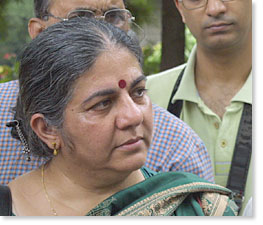 |
|
| Vandana
Shiva at a press conference with other leaders of an anti-WTO march in
New Delhi, August 27, 2003 . All photos by Nic Paget-Clarke.
|
|
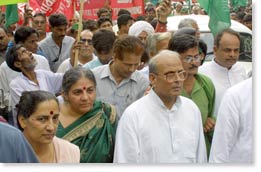 |
|
| Marching
with former Indian prime minister H. D. Deve Gowda and also two other
former primer ministers V.P. Singh and I.K. Gujral. |
|
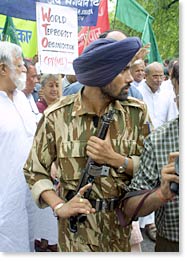 |
|
| A soldier of the Indian Army provides security for the former prime ministers marching in the anti-WTO rally in New Delhi.
|
|
 |
|
| On the march in New Delhi.
|
|
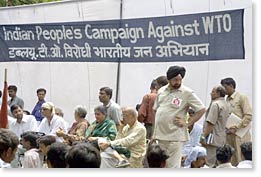 |
|
| On the stage at the rally against WTO.. |
|
 |
|
| At the rally. |
|
| More photos.
|
|
In
|


- A twist in the history of patents
- Control of the technology
- The role of patents
- Globalization of U.S. patent laws
- Patents regulate life
- Medicine: from healing to profits
- Ecology and equity
- From theoretical physicist to advocate for biodiversity
- Agriculture and violence
- Focus on biotechnology and patenting
- The influence of Gandhi
- The death of economic democracy
- The recovery of economic democracy
- The flow of wealth from South to North
- From ownership of land to ownership of biodiversity
- War is globalization by other means
In Motion Magazine: I think sometimes people’s eyes glaze over when hearing about patents and legal matters, but in your book “Protect or Plunder – Understanding Intellectual Property Rights” you describe some interesting history, about how originally patents were used to spread technology but now they have been turned into their opposite. Could you outline how that twist happened?
Vandana Shiva: In the early days, the word patent was used for two things. In the case of getting hold of territory, what were issued by kings and queens were letters-patent, which were open letters. Anyone could know that Columbus had been given a right by Queen Isabel and King Ferdinand to conquer and take over any territory on their behalf.
But the second meaning, defined around the same time by the Venetian laws on patent, which were the first patent laws, was that a master craftsman could be brought (to a country), because technology at that time was craft technology, and if a country could not make glass they would give to the master craftsman apprentices and say, “Train our people in this art.” “Train our people to make glass.” “Train our people to make steel.” “Train our people to make textiles”, and we will give you an exclusive right (to make these products) for seven years while you are training people.
The period of the patent was seven years because it took seven years to learn a craft. After that seven years was over, the master craftsman went back to wherever he belonged and you had all the apprentices available in the country to spread that technology as a free public good. This was the pattern throughout the early use of patent law.
Then you get slow shifts with the rise of industrialism. As big industry became a major economic interest, they started to use technology as an instrument of monopoly. Patents became the way to say, “Only we will use this technology”.
The way they expanded this power was, on the one hand, extending the life of patents. It went from seven years to fourteen. Now, under WTO (World Trade Organization), for the first time it is twenty years -- extendible in a period where technologies are becoming so obsolete that if you have that kind of monopoly for twenty years you are totally controlling the technology.
And the second thing is constantly increasing the domain over which patents will apply. For example, in India’s patent law agriculture could not be touched. Agriculture was free of monopolies. And in medicine you could not have a product monopoly. You could not monopolize a medicine but you could monopolize a method of making a medicine. But, medicine has been brought into monopolies. Seed has been brought into monopolies. Cells have brought into monopolies. Genes have been brought into monopolies. Animals have been brought into monopolies.
Basically, the ’80s saw a twist in this and a lot of it had to do with the rise of the big industry and their convergence into one set of giants, which are the health giants, the pharmaceutical giants, the gene giants controlling all life.
Control of the technology
In Motion Magazine: You’ve also said that with the rise of other countries in the world, with their own manufacturing systems, markets started to slip away but the developed countries still had control of the technology?
Vandana Shiva: The thing was that when we were living in a world based on crafts, transferring technology was the objective. But as the world got industrialized, as developing countries shed the colonial burden, imperialistic patent law started to develop.
For example, again India, under a 1970 law, developed a very strong medical sector. And I think if WTO had not come on the horizon, India would be providing cheap medicine to American citizens. It’s capable of doing that. But the American citizens, and the African citizens, and the Brazilian citizens, and in the future the India citizens are being told, “You will only buy from these monopolies.” It was a way to de-industrialize Southern countries who had started to build capacity, technological capacity for themselves.
The role of patents
In Motion Magazine: So patents have had a very specific role in the latest version of imperialism, in this globalization phase?
Vandana Shiva: If you want to have one tool for imperialistic control, it’s patent law under the WTO agreement. It’s in my view the worst of the WTO agreements. It is a totally coercive tool. It has only a negative function: to prevent others from doing their own thing; to prevent people from having food; to prevent people from having medicine; to prevent countries from having technological capacity. It is a negative tool for creating underdevelopment.
It’s the privatization of knowledge. I have called it the enclosure, the ultimate enclosure. We had enclosures of land. Now, we are seeing enclosures of biodiversity, life itself. In my book “Biopiracy”, I’ve talked about how this is the last colony. It is the spaces within our minds -- for knowledge. The spaces within life forms for reproduction. A seed cannot reproduce without permission of the patent holder and the company. Knowledge cannot be transmitted without permission and license collection. It’s rent collection from life. It’s rent collection from being human, and thinking, and knowing.
Globalization of U.S. patent laws
In Motion Magazine: How has the WTO been a forum for the globalization of U.S. patent laws?
Vandana Shiva: The WTO has an agreement called Trade Related Intellectual Property Rights agreement (TRIPs), which basically is nothing more than globalization of U.S.-style laws. And its globalization of U.S.-style laws both in content and in process. In terms of content, in the late ’80s when this law was drafted, the United States was the only country that granted patents on life forms. This precedent was set in a 1980 decision on a genetically-engineered micro-organism, subsequent to which was the rise of the biotech industry. The granting of life patents was seen as an imperative both by the industry as well as the government. The U.S. government actually encouraged life patenting. The decision-making was set by the courts, rather than by Congress, never with a public debate, never with a public policy decision on the ethical implications, ecological implications, economic implications of what life patents mean.
The second way in which this is a globalization of U.S. law is the fact that it was really U.S. companies which got together, drafted the law, took it to the U.S. administration, then took it to the secretariat of the at-that-time General Agreement on Trade and Tariffs (GATT), which was the precursor of WTO, and as Monsanto, which was one of the companies in the intellectual property coalition admitted in drafting this law, “We achieved something unprecedented. We were the patient, the diagnostician, and the physician all in one.
Patents regulate life
With the broadening of patents to life forms, patents do not just regulate technology they regulate life. They regulate economy. They regulate basic needs. A patent is an exclusive right to make, produce, distribute, or sell the patented product. So, if a patent is granted, for example, on seed it means a farmer who grows a seed cannot save seed from the harvested crop because that is constituted as making the seed and the exclusive right to the seed belongs to the company. It means seed-saving by farmers is now defined as intellectual property theft. Many farmers in the United States have been sued by the corporations for doing something normal in farming, which is saving their seed.
Exchanging seed with your neighbor, which is called brown-bagging -- it was not a commercial exercise; it was a mutual give-and-take in society; a social act of exchange for non-profit activity -- has also been defined as an infringement because now distributing is covered by a patent, even if it is not commercial, because the companies interpret that by exchanging seed you are taking the market away from them.
Medicine: from healing to profits
Also, patents can be given for medicine. For example, in the case of medicine, if there is no patent we can treat people with AIDS with $200 expenditure per year. Indian companies can make it for that cost because they can make them as generic drugs. They are not piracy drugs, which is the way the U.S. pharmaceutical industry talks about them. They are generic in the sense that different processes have been used. The same medicine, the same retroviral, costs $20,000 in the United States because of patenting -- that is the only difference. Which means something which is being made for $200 is being sold to consumers for not just ten times but a hundred times the price. As our prime minister said, the big companies are trying to turn the matter of disease from healing into a matter of profits.
There was an attempt made, at the beginning of the TRIPs negotiations, to make it look like the lower-cost production that could happen in the absence of monopolies was piracy. The industry managed to define piracy as absence of monopolies. We want to define monopoly as monopoly and recognize that things like seeds should be accessible to farmers, things like medicine should be accessible to those who are dying of AIDS, and no regime in the world can put profits above people’s lives.
In Motion Magazine: Are the same corporations controlling food and health?
Vandana Shiva: It’s the same companies. The industry that used to be the chemical industry is also the pharmaceutical industry, is also the seed industry, is also the biotech industry. There is no separation -- and agro-chemical industry. It is all one.
Ecology and equity
In Motion Magazine:You made the statement in your book on patents that there’s always a connection between ecology and equity. Can you talk about that?
Vandana Shiva: Ecology is about interactions in the natural world, sustainability of resources. Whether you look at water, you look at biodiversity, you look at anything, conservation happens. Environmental sustainability takes place when people have a stake and a share in the rewards of the conserved resource. If people have the ability to drink water from a well, and look after that well, and will suffer the consequences of contamination, they will not contaminate that well. People who pollute a well or a river are the ones who don’t have to drink from it.
Similarly, when it comes to monopolies on intellectual property, conservation is what is sacrificed. It’s the small peasants of the world who have conserved biodiversity. If they have to continue conserving biodiversity, they need to have their rights defended. They need to be able to know that when they plant basmati rice it will be their reward to harvest that basmati. They will not be treated as pieces of RiceTec property. And they need to have a market for their produce.
Intellectual property destabilizes both, and in fact, starts to become an incentive for destruction of biodiversity by pressures of the industry for monocultures, on the one hand, but also by not giving people a chance to protect the resources from which they make a living because they are no more their resources.
That is why ecology goes hand-in-hand with equity.
From theoretical physicist to advocate for biodiversity
In Motion Magazine: Could you go over how you started in the field of physics and then ended up where you are today and how that relates to your organizing?
Vandana Shiva: I chose to be a physicist. I loved physics from an age when I didn’t even know what the content was but I knew I wanted to figure out how nature works. Einstein was my hero. This is what inspired me.
I lived through life training to be a physicist, initially training to be a nuclear physicist and then realizing there’s a dark side to it. I left that to become a theoretical physicist. I worked in foundations of quantum theory.
As is typical, I was doing my Ph.D. in Canada and everyone who goes from the South as a scientist stays on and becomes a university professor and I could see, “That’s what I will become.” I wanted to become that. But I said, “I’m not informed enough about how my society works. There is a question in my mind. We have the third biggest scientific community in the world. We are among the poorest of countries. Science and technology is supposed to create growth, remove poverty. Where is the gap? Why is science and technology not removing poverty?” I wanted to answer that question to myself.
I said, “I will take off three years. Look at science policy issues. Be a little more educated, socially, and then go back to physics.” That was my chosen life path. I was, in any way, involved in forest protection in the Himalayas, my home, before I went for a Ph.D. I constantly volunteered with a movement of women called Chipko .
But when I started to work on science and technology issues, I realized very quickly that they are about resource control. They are not about efficiency. A big trawler in the sea is not more efficient than a small boat. It controls more resources. And denies the small boat.
Green Revolution farming is not more efficient. It takes more water and leaves other areas deprived of financial investment, water inputs, everything else. What you really see is technology acting as, what I called in that period, a polarizer of resource access. Very quickly I started to realize that technology issues, ecology issues, social inequality issues, were actually very intimately connected. I did a lot of analysis/writing at that point and I was invited by the United Nations to carry these issues further.
Meantime, the Ministry of Environment, seeing some of my reports, commissioned me to look at mining in my valley. I had just had my son, the 21-year-old boy who is walking around (in the office where this interview took place), and I said “perfect”. I had lost my mother at that time, so I said “I will go back, look at this mining, make a break in my science policy, also make a short break from my return to physics. Do the study. He’ll be a little older. But I will also do more work on ecology and the grassroots movement. Did the study. We stopped the mine.
Agriculture and violence
I started to do the United Nations work and a huge world unfolded. The Punjab crisis burst which forced me to look at agriculture, ecology issues of agriculture, but also the rise of terrorism linked to unequal development. I wrote my book called “The Violence of the Green Revolution”.
1984 was the year I started to look very, very closely at those issues because we’d had genocide in Punjab. We’d lost our prime minister in that terrorism, which eventually killed 30,000 people. And it was the year of Bhopal. As a result of that gas leak from a pesticide plant, 30,000 people more have died.
So, I was just surrounded by these mega-violent epidemics all linked to agriculture and agriculture that was supposed to be progressive. In 1984, I decided that something was wrong and I needed to go to the roots of it. Why has agriculture gone so violent? Why are we so dependent on pesticides -- weapons of mass destruction? The real weapons of mass destruction because they did move from the war industry into agriculture.
Focus on biotechnology and patenting
After three of four years of looking more closely at agriculture issues, I started to get called into biotechnology seminars because it was the next step. In ’87, at one of these seminars, the industry laid out its grand dream of controlling the world. They talked about needing genetic engineering so that there’s a technology that they have that peasants can’t use so that they can have a monopoly through technology. Patents. Because without it they cannot consolidate power.
That was said by Sandoz. Sandoz merged later with Ceiber-Geigy. Sandoz and Ceiber-Geigy became Novartis. Novartis merged with AstroZeneca, which was anyway two independent companies, earlier. All of them merged to become Syngenta. What they had said at that time was, “By the turn of the century we will be five.” In ’87, I said, “I don’t want to live in a world where five giant companies control our health and our food.”
I dropped everything else. I left my work on dams and forests and mines. I was doing very broad-scale work on the environment movement then. Dropped everything else. Handed it over to the next generation -- and they were brilliant activists in India -- and moved into a focus on two things: biotechnology and patenting.
I tracked the whole TRIPs negotiations through and have followed the biotech industry from the day it wanted to become a giant industry. I have tried to do my best to defend the freedom of people; create seed banks so that farmers have free seed; nature has freedom of diversity; and these monopolies are restrained.
Since 1987 to now, which is 16 years, I have had a single pointed attention to prevent imperialism over life itself.
The influence of Gandhi
In Motion Magazine: When you are working with the various farmers’ organizations, various mass organizations, specifically in India do people consciously learn from what Gandhi had to say? (See photo of Gandhi's working room, the Harijan Ashram by the Sabarmati River, Ahmedabad, Gujarat, India.) Vandana Shiva: Definitely. People very, very much learn from what Gandhi had said. When I brought the TRIPs issues for the first time to farmers’ organizations in India, in ’91 when the first draft of the WTO texts were ready, it was called the Dunkel draft text, I started to tell people what this would imply. It took no time: by ’92, ’93, we had giant farmer rallies. And the title (of the movement) was the Seed Satyagraha -- the non-violent, non-cooperation with laws that create seed monopolies, inspired totally by Gandhi walking to the Dandi Beach and picking the salt and saying, “You can’t monopolize this which we need for life.”
On the non-cooperation side we were very inspired by Gandhi. But also on the constructive side, the other side of our work with farmers and farm groups is the creative side of saving seeds, doing agriculture without corporate dependence -- without chemicals, without their seed. All this is talked about in the language that Gandhi left us as a legacy.
We work with three key concepts. (One) Swadeshi -- which means the capacity to do your own thing -- produce your own food, produce your own goods.
(Two) Swaraj -- to govern yourself. And we fight on three fronts -- water, food, and seed. JalSwaraj -- JalSwaraj is water independence -- water freedom and water sovereignty. Anna Swaraj is food freedom, food sovereignty. And Bija Swaraj is seed freedom and seed sovereignty.
(In regard to these fronts) Swa means self -- that which rises from the self and is very, very much a deep notion of freedom. I believe that these concepts, which are deep, deep, deep in Indian civilization, Gandhi resurrected them to fight for freedom. They are very important for today’s world because so far what we’ve had is centralized state rule, giving way now to centralized corporate control, and we need a third alternate. That third alternate is, in part, citizens being able to tell their states, “This is what your function is. This is what your obligations are,” and being able to have their states act on corporations to say, “This is something you cannot do.”
The third component is Satyagraha, non-cooperation, basically saying, “We will do our thing and any law that tries to say that us being free is illegal we will have to not cooperate with it. We will defend our freedoms to have access to water, access to seed, access to food, access to medicine.”
The death of economic democracy
In Motion Magazine: Last time we spoke, you were talking about how to make democracy more viable and you were saying that it comes down to individual participation at an economic level. How would that function?
Vandana Shiva: Well, actually any real, true democracy is one in which people can determine the conditions of their living -- their food, their health, their jobs, their livelihoods. These are defined as economic issues. They used to be covered by democratic governance of the representative kind to the extent that before globalization, if you voted someone to power you could put demands on that representative to say, “We need a school in this community, and if you promise you get us a school we are with you.” By and large, it was possible for politicians to come back and deliver their promise because it was within the national sovereign space.
But globalization has meant the erosion of national sovereign space. For example, under the agreement on agriculture nobody can guarantee a price to a farmer. Governments cannot go to farmers and say, “We will make sure you get a living price for your farm commodities.” They cannot go to a community and say, “We will defend your jobs and prevent them from being undermined and companies running off to some cheap overseas site.” They cannot offer guarantees on education, they cannot offer healthcare -- the typical things democracy was made of.
What we’ve seen is a split of democracy. It’s been emptied out of its economic content, been left with a representative shell of electoral theatrics -- literally.
Economic decisions have moved out of the hands of citizens and even of the hands of countries and moved into organizations controlled by corporations like the WTO, and the World Bank, the IMF (International Monetary Fund), and the corporations themselves. What we have is economic dictatorship combined with representative democracy. But representative democracy under economic dictatorship is not able to counter that dictatorship and act as an economic democratic force. (Rather it) moves and leans increasingly into winning votes by polarizing society and dividing society along lines of race, gender, religion, ethnicity. That is why over the ’90s, as globalization has deepened its reach in our communities and countries, fundamentalism, communalism, religious hatred have seen a rise. Because religious fundamentalism, I believe, is a child of the death of economic democracy.
In Motion Magazine: Because?
Vandana Shiva: Because people without economic rights are left insecure. There is joblessness. They can’t understand the processes leading to it. Ordinary farmers can’t really understand why prices are going down.
If you can say, “The prices are going down because some other farmer in some other state is doing something to you;” or, “Your water is disappearing because some other state is doing something;” or, “Your jobs are going because the Moslems are breeding too much;” or in Europe, “The immigrants are coming too fast; or in the United States, “The Mexicans are crossing the border;” it takes no time before the economic insecurity left as a result of globalization mutates into a ready-made ground for political interests to say, “Your job has been taken away by so and so.” “Your security has been robbed by so and so.” That’s the rhetoric that has filled the space as economic insecurity has grown.
The recovery of economic democracy
In Motion Magazine: How can a farmer, for example, economically become involved?
Vandana Shiva: I think the recovery of economic democracy is at the heart of recovery of democracy itself. And it doesn’t stop at that. It goes further into the creation of peace. In a way, we really have three combined challenges, just now. We’ve got the threat of war and violence. We’ve got the threat of economic insecurity, loss of jobs, loss of livelihoods, loss of incomes for farmers. And thirdly, we’ve got this whole situation that our leaders are not representing our will -- the collapse of democracy.
 |
|
| Making chipatis in Old Delhi.
|
|
 |
|
| Making saris.
|
|
 |
|
| Sacks of peppers in Old Delhi.
|
|
 |
|
| Spices for sale in Old Delhi.
|
|
 |
|
| Busy market area in Old Delhi.
|
|
 |
|
| Looking into the courtyard of a 400-year -old building.
|
If farmers are saving the seed, growing their crop, they are making reclamation of their economic space. They are giving up chemicals and the pesticides that have contaminated all sources of water in this country, including the soft drinks now. They are not just saving money. They are saving their lives and they are saving public health.
By reaching out to consumers and setting up alternate marketing systems, as we do with the Dilli Haat where we have our direct marketing stall, we in Navdanya, my organization, which is the main outlet for organic growers in this country, we bring the produce directly from farmers, and it’s literally their marketing platform. The flow of wealth from South to North
In Motion Magazine: The contradiction between knowledge, as a collective process, and patents being the opposite of that … do you think that is related to the fact that wealth has been flowing from one half of the world to the other? Vandana Shiva: North-South inequality is very clearly a result of imperialistic structures being put in place that suck wealth out of the South, put it in the North. That’s exactly why the North looks rich and the South looks poor. Not because human beings in the South don’t know how to create wealth. Everyone knows how to make things, create things. Every one is creative. But when the results of your creativity, productivity are not yours to hold and the results of your labor and creativity are transferred somewhere else the one who takes it becomes rich and the one who’s left without it is the one who stays poor.
During colonial rule, this extraction was done through ownership over land. The British came to India to a country, which was richer than England at that time, and every record tells you that. They used to exchange pepper with bags of gold. A sack of pepper used to be equal to a sack of gold. Then they came in as traders, established themselves as rulers. First as the East India Company, which was thrown out in the 1857 Rebellion and War of Independence, then, as the crown which took over the role of the Company and continued to rule. The regions that were the richest, such as Bengal, became the poorest. In 1942, two million people died of famine in the land where there was no shortage of wheat. Amartya Sen got a Nobel prize for saying something so basic, that people did not die because there was not enough food. They died because they had been robbed of their entitlement. That was the basis of his Nobel prize. That is also the basis of noticing inequality.
We (Navdanya) have two books on the history of food and farming and we have tracked in them what the wealth of Indian peasants was being used for. Schools were being built in England. Mental asylums were being run by the transfer of peasant wealth into England. That’s why the colonizing empire constantly grew. That’s what land ownership did at that time, which the British institutionalized in this country. Before that we had land use. We had use-of-it right. Not private property in land.
The British turned the revenue collectors into landowners and created what they called the permanent settlement and Zamidari system through which wealth would flow to them. The revenue collectors were left as landowners. The original cultivators were left as the dispossessed peasants.
From ownership of land to ownership of biodiversity
What ownership over land, a very distorted ownership of a land, did to indigenous communities at that time of colonialism, ownership over biodiversity, seeds, genes, medicine is doing in today’s world. The biodiversity is in what is called the poorer part of the world. We are biodiversity rich but every year, annually, $60 billion worth of wealth-transfer is taking place because the control over the products is in the hands of the North. Monopolies of patents are in their hands. Monopolies on trade are in their hands.
Coffee -- trade jumped from $40 billion to $70 billion over the last few years so there was literally a doubling of trade. One would have imagined a doubling of trade would have left a doubling of incomes in the hands of those who grew the coffee. The incomes of the coffee producers dropped from $9 billion to $5 billion and some of the most dispossessed people of the world today are the coffee growers, as also every other commodity grower.
These are amazing mechanisms -- the trade arrangements, trade treaties, intellectual property rights patent treaties. They are doing, once again, in a deeper way what colonialism did and the projections are that 70% of American wealth will be through rent collection, through patents, because the U.S government is not designing America as a society where people are involved in making things. It has dismantled manufacture. It has gone off to China. Pick up anything in a supermarket -- it is made in China. But America would still like to collect returns and that is through intellectual property. So, while people’s jobs are disappearing, the corporate wealth is increasing and then, of course, all the details of the rest of it carry on.
There are all these mechanisms of taking wealth from those who work, those who create, to those who control through extremely coercive instruments of power.
War is globalization by other means
In Motion Magazine: Which is now further enforced by invading other people’s countries?
Vandana Shiva: I have said that war is another name for globalization because if you really look at Iraq it wasn’t liberated. American soldiers didn’t come out winning. More of them have died since the so-called war got over. But one thing did happen and that was that corporate America got to enter Iraq and use American tax money in the process. Bechtel got a big contract. Halliburton got a big contract. That is where the whole so-called reconstruction went. This is exactly what globalization does – (for example) put the water of the world in the hands of Bechtel, Suez (Lyonnaise des Eaux), Vivendi (Environment). Globalization is war by other means and war is globalization by other means.
In Motion Magazine: It depends on the policy of the leaders of the U.S. at the time?
Vandana Shiva: At this point it so happens America is the empire. But one thing we learned with the British Empire is that empires rise and empires sink.
Published in In Motion Magazine March 28, 2004
Subscribe to:
Posts (Atom)