Tuesday, July 19, 2011

Joint course between Geography and Aboriginal Studies - Fall 2011

ENV4112 / EAS4364: Indigenous Environmental Knowledge


What is "traditional knowledge"? What is its source? Its value? How does it differ from "scientific knowledge"? Why is it discounted, yet sought after? Why has it become the subject of international controversy? This course explores these questions, emphasizing both Indigenous and environmental aspects. It requires students to personally engage their minds in another worldview to discover how traditional knowledge has practical importance for future survival. Both Canadian and international contexts are addressed.
 
This course will be led by Sonia Wesche and Rarihowkats (Haudnosaane nation). 

Monday, July 18, 2011

Kokomville Academy with Natasha, Brigette, Camila, Iana and Marcelo

This weekend we (Tasha, Brigette, Iana, Camila and –driver- Marcelo) will be going to Kokomville Academy to receive some Anishinaabe teachings from Elder Jacob Wawatie (Mowegan).

Kokomville Academy is a small School situated within the Wild life Reserve of La Verendrye in the Province of Quebec, Canada. The spirit of Kokomville Academy emerges from Mother Nature a study to learn the traditional Educational values of a family base within the boreal forest of North America. The “university of nature” is well grounded: to coexist in the Natural Environment following the teachings of Anishinaabe territory from Elder Jacob Wawatie.

This is a deliberate choice to integrate into our lives the indigenous perspectives of the territory in which we are welcome to live, to deploy our lives and to build our communities. Our sacred relations must be organized following the traditions of proud Algonquin people.

Because of the cosmic law of complementarity we want to contribute to the Kokomville Academy and we want to bring with us a laptop that can be used for a variety of purposes.

Would anyone be able to donate a working laptop or sell it at a solidarity price? We would really appreciate this gesture that will be transmitted to all those that will go through the awakening experience of Kokomville Academy in the days/months to come.

Please contact: maqexx@gmail.com

Chi meegweetch!

Friday, June 3, 2011

The Sustainable Relations course goes on!


This is what BEING RESPONSIBLE to our Future Generations looks like.

Brigette, you make us very proud and this is one of the greatest teachings you could have shown us, with courage, determination and responsibility.

Jallalla Brigette!

Monday, May 30, 2011

ROLL WITH THE DECLARATION – THE LAND, OUR LIFE


~~ Please spread the word ! ~~

ROLL WITH THE DECLARATION – “THE LAND, OUR LIFE”
Participatory Indigenous Solidarity Workshop with KAIROS, IPSMO - Barriere Lake Solidarity Collective and FAMILIES OF SISTERS IN SPIRIT

We will be making BANNERS!

1 pm – 5 pm
Saturday, June 4 2011
PSAC boardroom, 233 Gilmour St. Ottawa
Unceded and Unsurrendered Algonquin Territory

This workshop is open to everyone! Refreshment and snack will be provided.

Please R.S.V.P!

Special guests: Ed Bianchi, Kristen Gilchrist, Bridget Tolley, Tillis Wawatie Keye and Marcelo Saavedra-Vargas!

Come and learn about the UN Declaration on the Rights of Indigenous Peoples (UNDRIP), Mitchikanibikok Inik (the Algonquins of Barriere Lake) and Violence against Indigenous Women in Canada. As a part of the discussions, we will do a powerful exercise that explores the experience and impacts of colonization – the BLANKET exercise.

In the 2nd part of the workshop, we will collectively make banners to express our solidarity with the Algonquins of Barriere Lake and Indigenous Women in this country. These banners are a way to urge Canada to get to work on implementing this historic international agreement – UNDRIP – the minimum standard for the governments to fulfill their obligations for the right of Indigenous peoples to self-determination. These banners will then join other banners from across the country in a demonstration and march on June 20 Day of Action organized by KARIOS.

** We will ask for donations to cover the costs of materials for this event.

For more info:

Mitchikanibikok Inik (the Algonquins of Barriere Lake): http://www.barrierelakesolidarity.org/,
Violence against Indigenous Women in Canada: http://www.amnesty.ca/campaigns/sisters_overview.php,
Families of Sisters in Spirit: https://www.facebook.com/home.php?sk=group_126522944087041&ap=1,
Indigenous Peoples Solidarity Movement Ottawa: http://www.ipsmo.org/,
KAIROS: http://www.kairoscanada.org/, and
UN Declaration on the Rights of Indigenous Peoples: http://www.un.org/esa/socdev/unpfii/en/drip.html

Wednesday, May 25, 2011

Algonquin Sharing Day

Algonquin Sharing Day with Bob Lovelace, Lynn Gehl, Paula Sherman, and Bonita Lawrence - Saturday, June 25, 2011
Oshkabaywis Lynn Gehl

http://www.facebook.com/event.php?eid=101553219933546&notif_t=event_invite


Friday, May 20, 2011

THREE LITTLE BIRDS w/ Heather Black @ AlphaSoul Café


Time: Saturday, May 21 · 7:00pm - 11:00pm
Location:
Alpha Soul Cafe; 1015 Wellington St. West; Ottawa, Ontario

WANTED: NOT DEAD, BUT DEFINITELY NOT ALIVE.
Stephen Harper.

Now that we've got your attention, let me tell you a story. Two young girls were born upon a blue-moon. They spent their days wreaking havoc upon the civilians of their small town - through endless ukulele playing and the incessant squawk of oboes in the night. One day, a young dragon happened upon their path. With her locks of gold, her magical fairy box and the ability ...to spit fire, she (along with the other two) could now defeat the Blue Ice Man.

Under the creep of Conservatism, they were shooed from one establishment to the next as cold, blue ice began to cover the land (and ruin the arts. Not to mention slashing funding for woman's rights organizations, or aboriginal-led organizations for missing and murdered women). They ran further and further south taking shelter in crumbling mansions and decrepit taverns until the three BANDits fell upon their next underground.

The Alpha Soul Cafe!

Come out for a night of entertainment, a cup of coffee, or to satisfy your craving for artistic uprising. This is not something to be missed. Opening will be the smooth, vocal styling of local singer - songwriter Heather Black.


Doors a 7pm, show starts at 7:30.
 

10$

www.myspace.com/threelittlebirdstheband

www.myspace.com/sitablack

http://www.facebook.com/home.php#!/event.php?eid=153473554719536

http://www.facebook.com/home.php#!/pages/Three-Little-Birds/125760494113916

Saturday, May 7, 2011

The Law of Mother Earth: Behind Bolivia’s Historic Bill

Written by Nick Buxton  

Source: Yes Magazine

Indigenous and campesino (small-scale farmer) movements in the Andean nation of Bolivia are on the verge of pushing through one of the most radical environmental bills in global history. The "Mother Earth" law under debate in Bolivia's legislature will almost certainly be approved, as it has already been agreed to by the majority governing party, Movimiento Al Socialismo (MAS).

The law draws deeply on indigenous concepts that view nature as a sacred home, the Pachamama (Mother Earth) on which we intimately depend. As the law states, “Mother Earth is a living dynamic system made up of the undivided community of all living beings, who are all interconnected, interdependent and complementary, sharing a common destiny.”

The law would give nature legal rights, specifically the rights to life and regeneration, biodiversity, water, clean air, balance, and restoration. Bolivia's law mandates a fundamental ecological reorientation of Bolivia's economy and society, requiring all existing and future laws to adapt to the Mother Earth law and accept the ecological limits set by nature. It calls for public policy to be guided by Sumaj Kawsay (an indigenous concept meaning “living well,” or living in harmony with nature and people), rather than the current focus on producing more goods and stimulating consumption.

In practical terms, the law requires the government to transition from non-renewable to renewable energy; to develop new economic indicators that will assess the ecological impact of all economic activity; to carry out ecological audits of all private and state companies; to regulate and reduce greenhouse gas emissions; to develop policies of food and renewable energy sovereignty; to research and invest resources in energy efficiency, ecological practices, and organic agriculture; and to require all companies and individuals to be accountable for environmental contamination with a duty to restore damaged environments.

The law will be backed up by a new Ministry of Mother Earth, an inter-Ministry Advisory Council, and an Ombudsman. Undarico Pinto, leader of the 3.5 million-strong campesino movement CSUTCB, which helped draft the law, believes this legislation represents a turning point in Bolivian law: "Existing laws are not strong enough. This will make industry more transparent. It will allow people to regulate industry at national, regional, and local levels."

However, there is also strong awareness among Bolivia's social movements—in particular for the Pacto de Unidad (Unity Pact), a coalition of the country's five largest social movements and a key force behind the law—that the existence of a new law will not be enough to prompt real change in environmental practices.

A major obstacle is the fact that Bolivia is structurally dependent on extractive industries. Since the discovery of silver by the Spanish in the 16th Century, Bolivia's history has been tied to ruthless exploitation of its people and its environment in order to transfer wealth to the richest countries; poet and historian Eduardo Galeano’s famous book Open Veins draws largely on the brutal story of how Bolivia's exploitation fuelled the industrial expansion of Europe. In 2010, 70 percent of Bolivia's exports were still in the form of minerals, gas, and oil. This structural dependence will be very difficult to unravel.

Moreover, there is a great deal of opposition from powerful sectors, particularly mining and agro-industrial enterprises, to any ecological laws that would threaten profits. The main organization of soya producers, which claimed that the law “will make the productive sector inviable,” is one of many powerful groups who have already come out against the law. Within the government, there are many ministries and officials that would also like the law to remain nothing more than a visionary but ultimately meaningless statement.

Raul Prada, one of the advisors to Pacto de Unidad, explained that the Mother Earth law was developed by Bolivia's largest social movements in response to their perceived exclusion from policy-making by the MAS government, led by indigenous President Evo Morales. They have generally supported MAS since its resounding election victory in 2005, but were frustrated by what they saw as a lack of progress. Rather than merely expressing their concern, these movements—comprised mainly of indigenous and farming communities—are pro-actively developing a series of new laws. Their first priority was the passage of the Mother Earth Law, based on a commitment made at the historic global Peoples Conference on Climate Change held in Bolivia in April 2010. To some surprise, the diverse movements soon developed a consensual agreement that was supported by MAS legislators.

Raul Prada notes that, even with significant pressure from social movements, transitioning to an economy based on the concept Vivir Bien will not be easy. “It is going to be difficult to transit from an extractive economy. We clearly can't close mines straight away, but we can develop a model where this economy has less and less weight. It will need policies developed in participation with movements, particularly in areas such as food sovereignty. It will need redirection of investment and policies towards different ecological models of development. It will need the cooperation of the international community to develop regional economies that complement each other.”

Ultimately, though, this is a challenge far bigger than Bolivia, says Prada: “Our ecological and social crisis is not just a problem for Bolivia or Ecuador; it is a problem for all of us. We need to pull together peoples, researchers, and communities to develop real concrete alternatives so that the dominant systems of exploitation don't just continue by default. This is not an easy task, but I believe with international solidarity, we can and must succeed.”

Nick Buxton wrote this article for YES! Magazine, a national, nonprofit media organization that fuses powerful ideas with practical actions. He spent four years in Bolivia learning from movements fighting for social and environmental justice

Wednesday, May 4, 2011

Mining Injustice - In Toronto


Mining Injustice Solidarity Network is pleased to invite you to the third conference on the impact of Canadian mining on local communities throughout the world, which will take place the 6th - 8th of May of 2011, in Toronto.

FOR COMPLETE CONFERENCE SCHEDULE PLEASE VISIT: http://www.solidarityresponse.net/mining-injustice-conference/conference-agenda-2011/

This conference reflects the collective effort of several organizations and grass roots groups in Toronto, in collaboration with peoples, communities and organizations facing and resisting the entrance of corporate mining mega-projects into their territories.

****************************************************
Friday May 6th, 7 pm: Conference 'soft-launch' - meet and greet with affected community members and activists at Beit Zatoun (612 Markham Street)
RSVP here so we know how much food to bring!: http://www.facebook.com/event.php?eid=180292898686837

****************************************************
Saturday May 7th, 1:15 pm: keynote speaker Winona LaDuke and concurrent sessions as well as workshops and caucuses! (Sidney Smith Hall)

Official conference launch, 8 pm - 2 am: dance party (193 Dowling Street @ Queen Street West)

********************************************************
Sunday May 8th, 10 am: concurrent sessions as well as workshops and caucuses (cont.!) (Sidney Smith Hall)

********************************************************
Particular themes that will be discussed this year include:
• Gendered violence, inequity and feminist perspectives
• Militarization and forced displacement
• Indigenous knowledge and spirituality as forms of resistance
• Labour rights and the rhetoric of development
• Criminalization of dissent and protest
• Environmental contamination effects and health
• Food security and water rights
• The cycle of supply and demand of uranium in the North
• Tar sands and the petroleum industry in the North and South

++++++++++++++++++++++++++

Stay tuned for a list of speakers or visit our website at www.solidarityresponse.net

Endorsed by: AccentsBookstore, Barrio Nuevo, Bayan Canada, Canadians Against Mining in El Salvador, Centre for Research on Latin America and the Caribbean, Common Frontiers, CUPE 4400, CUPE 3903, Environmental Justice Toronto, First Continental Encounter of the Peoples of the Abya Yala-Ecuador, First Nations Solidarity Working Group, Guatemala Community Network – Toronto Kitchener-Waterloo Mayan Project – Tzijolaj-Ottawa, Health for All, Indigenous Environmental Network, Latin American and Caribbean Solidarity Network, Latin American Trade Union Coalition, Migrante, MiningWatch Canada, Munk OUT of UofT, NooneisIllegal, Ontario Coalition Against Poverty, Opirg Toronto, Osgoode Environmental Law Society, Philippines Solidarity Network of Canada, ProtestBarrick, Rights Action, Science for Peace, Students for a Free Tibet, Toronto Bolivia Solidarity, Todos por Guatemala, Workers Assembly.


If you would like to endorse this event please email Mining Injustice Solidarity Network at miconference2011@gmail.com

Friday, April 22, 2011

CLC resolutions on Barriere Lake

Justice for First Nations 6.Resolutions GR-62, GR-109, GR-162 and ESP-82: The Committee recommends concurrence in the following composite resolution: The Canadian Labour Congress (CLC) will
  • continue to demonstrate its support for justice for First Nations through the following activities: lobbying the federal government to enact June 21, National Aboriginal Day, as a `statutory holiday; 
  • calling on the federal government to establish a public enquiry into the cases of missing First Nations women across Canada, and the widespread violence perpetrated against First Nations women; 
  • continuing to work to build relationships with aboriginal and other women’s groups and lobby the federal, provincial and territorial governments and ensure that proper support and long term funding is applied to address Canada’s murdered and missing women; demanding the federal government declare that all First Nations children have an equal right to high-quality and culturally-relevant education. This requires more federal funding to ensure equitable class sizes, educational resources, staff salaries, special education services and indigenous language instruction;
  • supporting the inherent right of customary self-government for First Nations, and opposing efforts by the federal government to impose an
  • Indian Act election system on a First Nations community; and renewing our commitment to lobby governments to ensure First Nation treaty rights are respected;

Because First Nations in almost every measure are the most marginalized group in Canadian society; Because the voice of First Nations is among the least heard when governments discuss social policy; Because the CLC supports the self-determination of First Nations, and measures to acknowledge the historic and ongoing discrimination they have faced. Because this resolution is priority 6 of the General resolutions Commitee it should be passed

Barrière Lake 14.Resolutions ESP-14 and ESP-148: The Committee recommends concurrence in the following composite resolution:
The Canadian Labour Congress (CLC) will
work with affiliates and Federations of Labour to recognize and support the Algonquins of Barrière Lake's inherent right to customary self-government and call upon the Government of Canada to immediately reverse its imposition of an Indian Act
election system, and take action to honour the 1991 Trilateral Agreement with the Algonquins of Barrière Lake; The CLC will also continue to support to the Lubicon Cree in their efforts to achieve a just land rights agreement and demand the federal government take meaningful steps to resolve all outstanding land rights claims; Because the Algonquins of Barrière Lake have been living sustainably on their land for thousands of years; Because they have operated for countless generations under a traditional governance system connected to their use of the land; Because the Government of Canada is using section 74 of the Indian Act to abolish Barrière Lake's traditional governance system and impose a colonial electoral system; Because the Government of Canada has not honoured the signed 1991 Trilateral Agreement for environmental management/protection; Because the acclaimed Chief in the imposed section 74 election refused the position; Because Canada has a dismal record in resolving First Nations' land claim disputes; Because in 1990, the United Nations Human Rights Committee ruled that Canada had violated the human rights of the Lubicon Cree and yet a just settlement with the Lubicon remains outstanding; Because these are but a few examples of the need for federal action to resolve First Nations' land rights disputes.
Since this resolution in #14 in the economic and social policy report it may not be passed on the floor but will be supsequently passed at a CLC Executive COuncil meeting

Wednesday, April 13, 2011

Looking for Urban Aboriginal Adults (18+) to Participate in Research on Culture, Identity and Place in Ottawa

 Title of Research Project:            Community is Where I Find It:
Place-Making, Culture, and Identity Among Urban Aboriginal People in Ottawa,
Ontario
 
  • I am looking for research participants:
    • People who self-identify as Aboriginal (First Nations
    • Status or non-Status Indian, Metis, Inuit, or mixed Aboriginal heritage)
    • Aboriginal adults 18+, male and female
    • Must reside in Ottawa

Research participants will participate in a 60 to 120 minute video or audio
recorded interview.  Video recorded interviews will not provide anonymity
but audio recorded interviews will be anonymous. The topic of the interview
will be on your thoughts and experiences of urban Aboriginal culture and
identity as a resident of Ottawa, Ontario. One of the main purposes of the
research is to produce a short film on urban Aboriginal culture and identity
in Ottawa, Ontario and to show the vibrancy of urban Aboriginal life.

A gift/honourarium will be provided to participants with a value of
approximately $10. As transportation and child care can be barriers to
participation I can provide bus tickets as well as offer to pay for
childcare costs at the standard hourly rate for parents with children who do
not have access to childcare.

If you are interested in participating or would like any more information
please feel free to contact me, Cheryl Matthew at the Department of
Sociology and Anthropology, Carleton University, B753 Loeb Building, Phone:
(613) 899-3530 or by email cmatthew@connect.carleton.ca


This project has been reviewed and cleared by the Carleton University
Research Ethics Board 613-520-2517 or ethics@carleton.ca.

Wednesday, April 6, 2011

Permaculture activities coming up.

The Permaculture Project GTA - Spring 2011 Conference
April 9 & 10
358 Dufferin St., Toronto

Tentative Schedule
Saturday, April 9
  • 10am Sign in opens
  • 11am Ancestors invited - First nations ceremony by T a i a i a k o ' n H i s t o r i c a l P r e s e r v a t i o n S o c i e t y
  • 1130am Brief History of Toronto and Meet the community (meet and greet). Displays by Transition Toronto, Taiaiako'n Historical Preservation Society (High Park Burial Mounds), EcoEdge Designs, Heritage Canada, Whole Village (Caledon), Local Artist...and more!
  • 2pm Lets Rebuild Toronto CANVAS art live painting of green pontoon and design facilitated by Alaska B
  • 3pm Concert by Maracatu Baque do Mangue
  • 330pm Break - FOOD
  • 345pm Welcome note by TPPGTA Founder & Director Toyin Coker, with Douglas Barnes and Puck on Signing bowl
  • 4pm Permaculture Principles in Community Organizing - Workshop by Bonita Ford
  • 445pm Seed Saving 101 with Rosy
  • 5pm Dumpstering / foraging workshop (Rapid Analysis)
  • 515pm Designing with compromise by Douglas J E Barnes
  • 6pm Check in and Check Out

Sunday, April 10
  • 3pm Permaculture Curriculum planning & Visioning session with Jane Hayes & Douglas Barnes
  • 4pm Community review - Project critic (review of current projects in GTA)
  • 6pm Hands On! - everyone makes seed balls. New Product Demo by Hala Chaoui. BioChar Demo by Lloyd Heferty.
  • 730pm TPPGTA announcements and call out - all upcoming projects and opportunities

Cost: $70 - includes registration and food
Contact: tppgta@gmail.com

____________________________

Liberation Permaculture: A Panel Discussion
Thursday, April 21, 7:30pm-10:00pm
Bronson Centre, 211 Bronson Ave, Room 221 - Ottawa

How can ecological design confront oppression and foster social justice?

Bonita will be one of the panelists for this evening.  Come out and connect with the growing permaculture community in Ottawa.

Pay what you want
Permaculture Project Ottawa & Common Cause Ontario
Refreshments provided by the G-Spot

Contact: permaculture.project.ottawa@gmail.com

____________________________

Ecological Design and Gardening: Intro to Permaculture
April 29 to May 1


This course is completely full. 

Please stay tuned for the Introduction Course and the full Permaculture Design Course in fall 2011 offered by the Permaculture Institute of Eastern Ontario.  More details to come.

____________________________

Permaculture, Poetry & Revolution
June 11 & 12

A weekend workshop retreat including theory, practice and live spoken-word and musical performance

Using lectures, videos, art, on-the-ground observation and hands-on group projects and discussions, you will learn about:
~> Permaculture Ethics & Principles ~> Design Concepts, Priorities & Patterning ~> Waste Management & Water Harvesting ~> Food Forest Concepts ~> Appropriate Siting & Materials for Natural Building ~> Art & Activism ~> Economic Permaculture ~> Social
Justice, Community Organizing, Eco-Villages & Land Trusts

EARLY BIRD RATE (Available until May 21st): $150
Cost: $200 (Includes accommodations, food & artist fees)

WHERE: An environmental retreat centre with accommodations, inground pool (weather permitting), indoor/outdoor fireplaces & more
apx. 30 min. east of downtown Ottawa.

Contact: Graeme at 819-351-6113 or at graeme.j.ofarrell@gmail.comC

____________________________

Permaculture Convergence
Saturday, June 25 - all day

Ottawa East


Online registration/guest list will be open shortly.  Stay tuned for more details.  Please save the date!

1-day permaculture convergence in Ottawa, gathering the permaculture community in Eastern Ontario.

· Presentations by permaculture teachers & students in the morning.
· “Open Space Technology” to discuss next steps in the afternoon.

By donation to support local projects & permaculture education.
Sponsored by the Permaculture Institute of Eastern Ontario

Tuesday, March 29, 2011

Bob Thomson's lecture in class - listen online!


Click the media player below to listen to Bob's lecture for our course Sustainable Relations: a vision of indigenous peoples.


Tuesday, March 22, 2011

Mandala

Our common Mandala

The word "mandala" is from the classical Indian language of Sanskrit. Loosely translated to mean "circle," a mandala is far more than a simple shape. It represents wholeness, and can be seen as a model for the organizational structure of life itself--a cosmic diagram that reminds us of our relation to the infinite, the world that extends both beyond and within our bodies and minds.

Describing both material and non-material realities, the mandala appears in all aspects of life: the celestial circles we call earth, sun, and moon, as well as conceptual circles of friends, family, and community.

A mandala is...
An integrated structure
organized around a
unifying center

Longchenpa
"The integrated view of the world represented by the mandala, while long embraced by some Eastern religions, has now begun to emerge in Western religious and secular cultures. Awareness of the mandala may have the potential of changing how we see ourselves, our planet, and perhaps even our own life purpose."
(From Mandala: Journey to the Center, by Bailey Cunningham)

creating unity Creating a group mandala is a unifying experience in which people can express themselves individually within a unified structure.
The Mandala Project workshops for children include the creation of a group mandala quilt. The students enjoy creating individual mandalas that are incorporated into a larger work of art. Creating a group mandala can be an enjoyable activity with friends. It can also provide an excellent closure to an event or workshop.
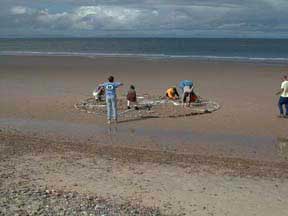
These photos of a beach rock mandala were taken by Mary Ann Rolfe. The mandala was made at the culmination of a week long workshop in August 1998 at Findhorn in the Northern part of Scotland.
Mary Ann writes about the experience:"We all brainstormed to decide on a closing project to celebrate the week and the wonderful connections we had made with people from all over the world, the Findhorn Foundation and with ourselves. "At this lovely North Sea beach, instead of sand we found incredible washed stones of every size and color. So, we began this impromptu creation knowing that part of the beauty would be in its temporary nature as the tides washed it away." See Mary Ann's personal mandala.
More examples of group mandalas:
Miguel Tomas' art classes in Spain
Regina Drummond's workshop in Costa Rica
cross-cultural patterns
The mandala pattern is used in many religious traditions. Hildegard von Bingen, a Christian nun in the 12th century, created many beautiful mandalas to express her visions and beliefs.
In the Americas, Indians have created medicine wheels and sand mandalas. The circular Aztec calendar was both a timekeeping device and a religious expression of ancient Aztecs.
In Asia, the Taoist "yin-yang" symbol represents opposition as well as interdependence. Tibetan mandalas are often highly intricate illustrations of religious significance that are used for meditation.
different cultures, similar expressions
Both Navajo Indians and Tibetan monks create sand mandalas to demonstrate the impermanence of life.
In ancient Tibet, as part of a spiritual practice, monks created intricate mandalas with colored sand made of crushed semiprecious stones. The tradition continues to this day as the monks travel to different cultures around the world to create sand mandalas and educate people about the culture of Tibet.
The creation of a sand mandala requires many hours and days to complete. Each mandala contains many symbols that must be perfectly reproduced each time the mandala is created. When finished, the monks gather in a colorful ceremony, chanting in deep tones as they sweep their mandala into a jar and empty it into a nearby body of water as a blessing. This action also symbolizes symbolizes the cycle of life.

A world away, the American Navajo people also create impermanent sand paintings which are used in spiritual rituals–in much the same way as as they are used by Tibetans. A Navajo sandpainting ritual may last from five to nine days and range in size from three to fifteen feet or more.
Learn more about Tibetan art and culture
Learn more about Navajo Sand Paintings
mandalas in architecture
From Buddhist stupas to Muslim mosques and Christian cathedrals, the principle of a structure built around a center is a common theme in architecture.
Native American teepees are conical shapes built around a pole that represents the "axis mundi" or world axis.
Buckminster Fuller expanded on the dome design with his famous geodesic dome structures. The dome structure has the highest ratio of enclosed area to external surface area, and all structural members contribute equally to the whole--a great structural representation of a mandala!
micro to macro
Representing the universe itself, a mandala is both the microcosm and the macrocosm, and we are all part of its intricate design. The mandala is more than an image seen with our eyes; it is an actual moment in time. It can be can be used as a vehicle to explore art, science, religion and life itself. The mandala contains an encyclopedia of the finite and a road map to infinity.
Carl Jung said that a mandala symbolizes "a safe refuge of inner reconciliation and wholeness." It is "a synthesis of distinctive elements in a unified scheme representing the basic nature of existence." Jung used the mandala for his own personal growth and wrote about his experiences.
It is said by Tibetan Buddhists that a mandala consists of five "excellencies":
The teacher • The message • The audience • The site • The time
An audience or "viewer" is necessary to create a mandala. Where there is no you, there is no mandala. (from: You Are the Eyes of the World, by Longchenpa, translated by Lipman and Peterson).

Taken from: The Mandala Project (http://www.mandalaproject.org/Index.html).  In this site you can view hundreds of mandalas.

Friday, March 11, 2011

Our guest speaker: Bob Thomson

Author Bob Thomson will be our guest speaker this Monday March 14 for our course EAS "Sustainable Relations". He knows about Suma Qamaña (this is in Aymara, in Quechua it is Sumak Kausay) and his latest article about Degrowth and the Pachakut'i can be found here: http://bit.ly/gpIZCK . Please read his article to be well prepared for his visit.


This is a very concise biography about Bob Thomson:


From 1994 to 2000, Bob Thomson was the founder and Managing Director of TransFair Canada, Canadian affiliate of Fairtrade Labelling Organizations International (FLO), a 17 nation certification body promoting a fair trade label for coffee and other foods/commodities. 

He was Co-ordinator of the Ottawa Food Security Council (now Just Food) in 2003/2004 and the Facilitator of the Export Credit Agency Watch network in Paris from 2005 to 2008. Bob has a degree in Civil Engineering (U of T 1968) and an M.A. in International Affairs (Carleton 1983). 

He has lived and worked in Peru, the Caribbean, France and Canada and has extensive experience with NGO programme and project evaluations, fair trade producer support, non-profit governance, housing co-operatives, computer assisted communications for civil society, and finance and the environment. He is currently involved in organizing an international conference on convivial degrowth in Montreal at the end of May 2012 and now calls himself a Slowcialist. 

Visit his web site at http://slowcialism.wordpress.com.

Wednesday, March 9, 2011

Drake equation

This is the equation Frank Drake wrote on the blackboard in 1961:

N = R fp ne fl fi fc L

Each term to the right of the equals sign represents one of the questions we asked earlier:
R is the rate of star formation within the Galaxy, expressed in stars per year (approx.: 100 billion);
fp is the fraction of stars that form planets (approx.: 20% to 50%);
ne is the average number of planets each such star possesses, which are capable of supporting life (from 1 to 5);
fl is the fraction of those planets where life actually occurs (from 100% -resilience of life- to 0%);
fi is the fraction of life-bearing planets where intelligence arises (from 100% to 0%, depending on your assumptions);
fc is the fraction of intelligent life-bearing planets where intelligent beings develop the ability to communicate beyond their own world; and
L is the length of time, in years, that such communications remain detectable.

By estimating values for each of these terms and multiplying them together, one arrives at:

N, the estimated number of detectable civilizations.

TO CALCULATE 'N' follow this link: Drake equation calculator

Sunday, March 6, 2011

Our guest: Brewster Kneen

Brewster Kneen was born in Ohio and studied economics and theology in the U.S. and the U.K. before moving to Toronto in 1965. There he produced public affairs programs for CBC Radio, and worked as a consultant to the churches on issues of social and economic justice. In 1971, with his wife Cathleen and their children Jamie and Rebecca, he moved to Nova Scotia, where they farmed until 1986, starting with a cow-calf operation and then developing a large commercial sheep farm.
For many years Brewster was secretary of the Sheep Producers Association of Nova Scotia and in the early 1980s he organized the Northumberland Lamb Marketing Co-operative (Northumberlamb) and the Brookside Abattoir Co-operative, both farmer owned and operated. In 1980, the Kneens started publishing The Ram's Horn.
In 1986 the Kneens returned to Toronto and Brewster began his career of writing and lecturing on the food system, with increasing attention to biotechnology. He received two grants from the Social Sciences and Humanities Research Council as an Independent Scholar for research into 'technological determinism' and in 1994-5 he was a Senior Fellow of the Faculty of Environmental Studies, York University. Brewster was also a founding member of the Toronto Food Policy Council. During this time he wrote his first four books.
The Kneens lived in British Columbia from 1995 to 2006, first in Mission in the Fraser Valley and then at Left Fields (the farm operated by Rebecca Kneen and Brian MacIsaac) in Sorrento in the Shuswap. During this period Brewster wrote Farmageddon and Invisible Giant, 2nd edition, and engaged in public education and organizing, helping form the BC Biotechnology Circle and the Canadian Biotechnology Action Network (CBAN). In 2006 the Kneens moved east to a more accessible location, Ottawa, where a bicycle replaces the automobile much of the time.
Much of his current focus is on the cultural and ideological underpinnings of public and political life.  His latest book, The Tyranny of Rights, was published in 2009.

Monday, February 28, 2011

The World Social Forum, Egypt, and Transformation


Commentary No. 299, Feb. 15, 2011
The World Social Forum (WSF) is alive and well. It just met in Dakar, Senegal from Feb. 6-11. By unforeseen coincidence, this was the week of the Egyptian people’s successful dethroning of Hosni Mubarak, which finally succeeded just as the WSF was in its closing session. The WSF spent the week cheering the Egyptians on – and discussing the meaning of the Tunisian/Egyptian revolutions for their program of transformation, for achieving another world that is possible – possible, not certain.
Somewhere between 60,000 and 100,000 people attended the Forum, which is in itself a remarkable number. To hold such an event, the WSF requires strong local social movements (which exist in Senegal) and a government that at least tolerates the holding of the Forum. The Senegalese government of Abdoulaye Wade was ready to “tolerate” the holding of the WSF, although already a few months ago it reneged on its promised financial assistance by three-quarters.
But then came the Tunisian and Egyptian uprisings, and the government got cold feet. What if the presence of the WSF inspired a similar uprising in Senegal? The government couldn’t cancel the affair, not with Lula of Brazil, Morales of Bolivia, and numerous African presidents coming. So it did the next best thing. It tried to sabotage the Forum. It did this by firing the Rector of the principal university where the Forum was being held, four days before the opening, and installing a new Rector, who promptly reversed the decision of the previous Rector to suspend classes during the WSF so that meeting rooms be available.
The result was organizational chaos for at least the first two days. In the end, the new Rector permitted the use of 40 of the more than 170 rooms needed. The organizers imaginatively set up tents across the campus, and the meeting proceeded despite the sabotage.
Was the Senegalese government right to be so frightened of the WSF? The WSF itself debated how relevant it was to popular uprisings in the Arab world and elsewhere, undertaken by people who had probably never heard of the WSF? The answer given by those in attendance reflected the long-standing division in its ranks. There were those who felt that ten years of WSF meetings had contributed significantly to the undermining of the legitimacy of neoliberal globalization, and that the message had seeped down everywhere. And there were those who felt that the uprisings showed that transformational politics lay elsewhere than in the WSF.
I myself found two striking things about the Dakar meeting. The first was that hardly anyone even mentioned the World Economic Forum at Davos. When the WSF was founded in 2001, it was founded as the anti-Davos. By 2011, Davos seemed so unimportant politically to those present that it was simply ignored.
The second was the degree to which everyone present noted the interconnection of all issues under discussion. In 2001, the WSF was primarily concerned with the negative economic consequences of neoliberalism. But at each meeting thereafter the WSF added other concerns – gender, environment (and particularly climate change), racism, health, the rights of indigenous peoples, labor struggles, human rights, access to water, food and energy availability. And suddenly at Dakar, no matter what was the theme of the session, its connections with the other concerns came to the fore. This it seems to me has been the great achievement of the WSF – to embrace more and more concerns and get everyone to see their intimate interconnections.
There was nonetheless one underlying complaint among those in attendance. People said correctly we all know what we’re against, but we should be laying out more clearly what it is we are for. This is what we can contribute to the Egyptian revolution and to the others that are going to come everywhere.
The problem is that there remains one unresolved difference among those who want another world. There are those who believe that what the world needs is more development, more modernization, and thereby the possibility of more equal distribution of resources. And there are those who believe that development and modernization are the civilizational curse of capitalism and that we need to rethink the basic cultural premises of a future world, which they call civilizational change.
Those who call for civilizational change do it under various umbrellas. There are the indigenous movements of the Americas (and elsewhere) who say they want a world based on what the Latin Americans call “buen vivir” – essentially a world based on good values, one that requires the slowing down of unlimited economic growth which, they say, the planet is too small to sustain.
If the indigenous movements center their demands around autonomy in order to control land rights in their communities, there are urban movements in other parts of the world who emphasize the ways in which unlimited growth is leading to climate disaster and new pandemics. And there are feminist movements who are underlining the link between the demands for unlimited growth and the maintenance of patriarchy.
This debate about a “civilizational crisis” has great implications for the kind of political action one endorses and the kind of role left parties seeking state power would play in the world transformation under discussion. It will not be easily resolved. But it is the crucial debate of the coming decade. If the left cannot resolve its differences on this key issue, then the collapse of the capitalist world-economy could well lead to a triumph of the world right and the construction of a new world-system worse even than the existing one.
For the moment, all eyes are on the Arab world and the degree to which the heroic efforts of the Egyptian people will transform politics throughout the Arab world. But the tinder for such uprisings exists everywhere, even in the wealthier regions of the world. As of the moment, we are justified in being semi-optimistic.